
Learning Objectives
2 objectivesBy the end of this note, you should be able to:
- 1.1.ADescribe a scalar or vector quantity using magnitude and direction, as appropriate.
- 1.1.BDescribe a vector sum in one dimension.
Scalars, Vectors, and How Physics Describes Quantities
Every measurement in physics falls into one of two categories, and knowing which category matters because it determines how you combine quantities and how you report answers on the exam.
A scalar is a quantity described by magnitude only. Magnitude just means size — a number with a unit. A vector is a quantity described by both magnitude and direction. Because vectors carry directional information, they behave differently from scalars when you add them.
Think of it this way: temperature is 22 °C. That number alone tells you everything. But saying an object moved 5 m is incomplete — you also need to say which way. That directional requirement is what makes a quantity a vector.
| Feature | Scalar | Vector |
|---|---|---|
| Described by | Magnitude only | Magnitude and direction |
| Examples | Distance, speed, mass, time, energy | Position, displacement, velocity, acceleration, force |
| Can be negative? | Only if the quantity itself permits it (e.g. temperature) | Yes — the sign indicates direction along an axis |
MisconceptionStudents often think a negative sign always means “less” or “smaller.” For vectors, a negative sign means the quantity points opposite to the chosen positive direction, not that it is small.
Exam TipAlways state your positive direction before assigning signs.
Representing Vectors as Arrows
Vector notation uses a small arrow above the symbol for a quantity: $\vec{v}$ for velocity, $\vec{a}$ for acceleration, $\vec{F}$ for force. When you see the arrow, the quantity includes direction. When the arrow is absent, the symbol refers to a component or a magnitude.
Vectors can be visually modeled as arrows. The arrow’s length is proportional to the vector’s magnitude, and the arrow points in the vector’s direction. A longer arrow means a larger magnitude. Two arrows of equal length represent two vectors of equal magnitude.
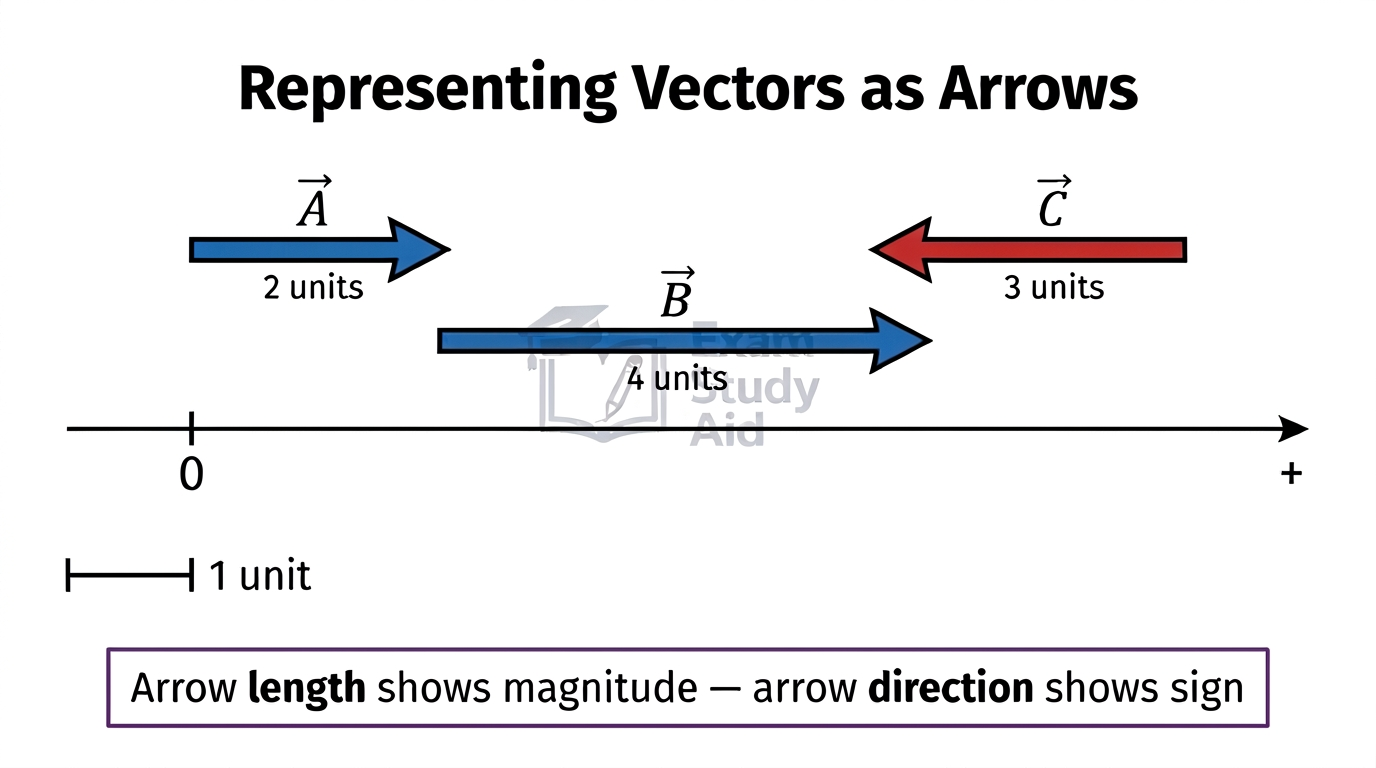
In one dimension, you do not need the arrow notation for components along an axis. The sign of the component completely describes the direction. For example, if rightward is positive, then $v=-3$ m/s means the object moves to the left at 3 m/s. The negative sign replaces the need for an arrow.
Distance vs Displacement and Speed vs Velocity
Two pairs of quantities highlight the scalar–vector distinction perfectly, and the AP exam tests whether you can keep them straight.
Distance is the total length of the path traveled. It is a scalar — always positive, with no direction. Displacement is the change in position from start to finish. It is a vector — it has magnitude and a direction (or sign in one dimension).
An object that walks 4 m east then 3 m west has traveled a distance of 7 m. Its displacement, however, is only 1 m east. The path does not matter for displacement; only the start and end positions matter.
Speed is how fast an object moves regardless of direction — a scalar. Velocity is the rate of change of position — a vector that includes direction.
| Property | Distance / Speed (Scalar) | Displacement / Velocity (Vector) |
|---|---|---|
| Definition | Total path length / rate of path length change | Change in position / rate of position change |
| Direction? | No | Yes |
| Can be zero even if object moved? | No (distance) | Yes — if the object returns to its start |
| SI unit | m / m/s | m / m/s (with sign or direction stated) |
Examiner InsightFRQs often ask “determine the displacement” and “determine the distance traveled” in the same problem to test whether you distinguish them.
Exam TipIf the question says “displacement,” your answer needs a sign or stated direction.
Vector Sums in One Dimension
Adding vectors in one dimension requires a coordinate system with a defined positive direction. Once you choose positive, every vector pointing that way gets a positive component, and every vector pointing the opposite way gets a negative component. The vector sum (also called the resultant) is then found by ordinary addition of these signed components.
Suppose three forces act on an object along a horizontal axis. Take rightward as positive.
| Force | Direction | Component |
|---|---|---|
| ${F}_{1}$ | Right | +5 N |
| ${F}_{2}$ | Left | −3 N |
| ${F}_{3}$ | Right | +2 N |
The vector sum is:
$${F}_{\text{net}}=(+5)+(-3)+(+2)=+4\text{ N}$$
The positive result means the net force is 4 N to the right. If the result had been negative, the net force would point to the left.
This sign rule applies to every one-dimensional vector addition: displacement, velocity, acceleration, force, and momentum. The process is always the same — assign signs based on direction, then add algebraically.
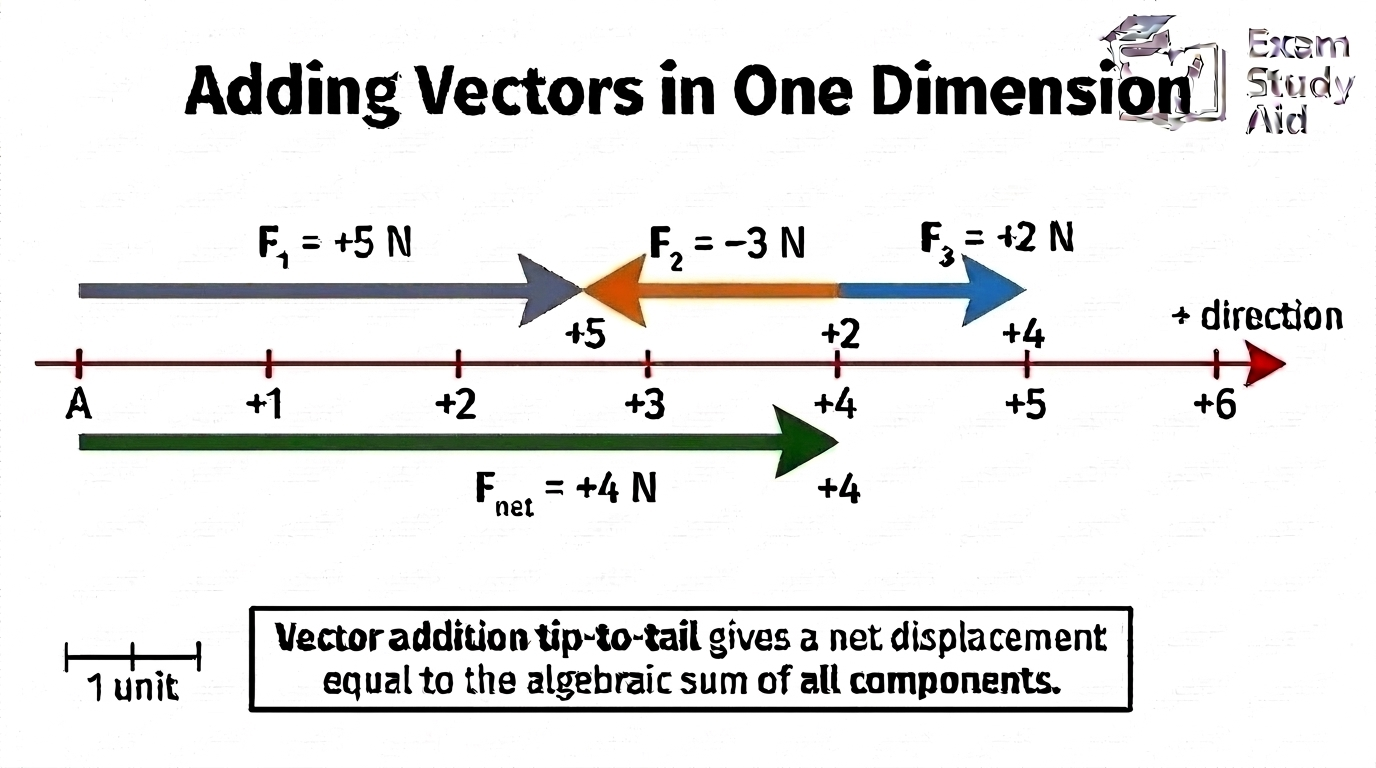
MisconceptionStudents sometimes add magnitudes without considering signs, getting 10 N instead of 4 N in the example above. Opposite directions require opposite signs before you add.
Exam TipWrite every component with its sign before performing the sum.
QUICK RECAP
Key Points
- Scalars have magnitude only; vectors have magnitude and direction.
- Distance and speed are scalars; displacement and velocity are vectors.
- Vectors are drawn as arrows with length proportional to magnitude.
- The arrow notation $\vec{v}$ indicates a full vector quantity.
- In one dimension, a sign replaces the arrow for components.
- Choose a positive direction before assigning signs.
- Opposite directions get opposite signs.
- The vector sum is the algebraic sum of signed components.
- A negative result means the direction is opposite to the positive axis.
- Displacement can be zero even when distance is nonzero.
- Speed is always zero or positive; velocity can be negative.
CAN I…? PROGRESS CHECK
Self-Assessment
- Classify a given quantity as a scalar or a vector and explain why?
- Distinguish between distance and displacement with a concrete example?
- Distinguish between speed and velocity with a concrete example?
- Assign correct signs to vector components given a coordinate axis?
- Calculate the vector sum of two or more vectors in one dimension?
- Interpret the sign of a resultant vector as a direction?