
Learning Objectives
3 objectivesBy the end of this note, you should be able to:
- 8.1.ADescribe the electric force that results from the interactions between charged objects or systems.
- 8.1.BDescribe the electric and gravitational forces that result from interactions between charged objects with mass.
- 8.1.CDescribe the electric permittivity of a material or medium.
Charge as a Fundamental Property
Electric charge is a fundamental property of all matter, just as mass is. Unlike mass, charge comes in two varieties: positive and negative.
Charge is a scalar quantity. It has magnitude and sign but no direction. The SI unit of charge is the coulomb (C).
The smallest indivisible amount of charge is the elementary charge e:
$$e=1.60\times {10}^{-19}\text{ C}$$
Every charged particle carries a whole-number multiple of e. No object can have 0.5e of charge. This is called charge quantization.
| Particle | Symbol | Charge |
|---|---|---|
| Proton | p | +e = +1.60 × 10⁻¹⁹ C |
| Electron | e⁻ | −e = −1.60 × 10⁻¹⁹ C |
| Neutron | n | 0 |
A point charge is a model that treats a charged object as if all its charge sits at a single point. The physical size of the object is negligible. This model works well when the distance between objects is much larger than their sizes.
MisconceptionStudents sometimes write charge with a direction. Charge is a scalar: positive or negative, never "pointing" anywhere. The force between charges is a vector, but the charge itself is not.
Exam TipWhen stating the charge of an electron, always write −e or −1.60 × 10⁻¹⁹ C, including the negative sign.
Coulomb's Law
Coulomb's law describes the electrostatic force between two point charges. This is the foundational equation for all of electrostatics, so every detail matters.
Key Equations
Coulomb's law:
$${F}_{E}=\frac{1}{4\pi {\epsilon }_{0}}\frac{∥{q}_{1}∥∥{q}_{2}∥}{{r}^{2}}$$
Variables:
- ${F}_{E}$ = magnitude of the electrostatic force (N)
- ${q}_{1}$ = charge of the first object (C)
- ${q}_{2}$ = charge of the second object (C)
- $r$ = distance between the centers of the two charges (m)
- ${\epsilon }_{0}$ = permittivity of free space = 8.85 × 10⁻¹² C²/(N·m²)
SI unit: newton (N)
Rearrangements:
$$r=\sqrt{\frac{∥{q}_{1}∥∥{q}_{2}∥}{4\pi {\epsilon }_{0}{F}_{E}}}$$
$$∥{q}_{1}∥=\frac{4\pi {\epsilon }_{0}{F}_{E}{r}^{2}}{∥{q}_{2}∥}$$
ProportionalityThe electrostatic force is directly proportional to the magnitude of each charge. It is inversely proportional to the square of the distance. Doubling one charge doubles the force. Doubling the distance reduces the force to one quarter.
Reference sheet status: On the reference sheet.
The constant $\frac{1}{4\pi {\epsilon }_{0}}$ is often written as $k$:
$$k=\frac{1}{4\pi {\epsilon }_{0}}\approx 8.99\times {10}^{9}{\text{ N}\cdot\text{m}}^{2}/{\text{C}}^{2}$$
So Coulomb's law is equivalently written:
$${F}_{E}=\frac{k∥{q}_{1}∥∥{q}_{2}∥}{{r}^{2}}$$
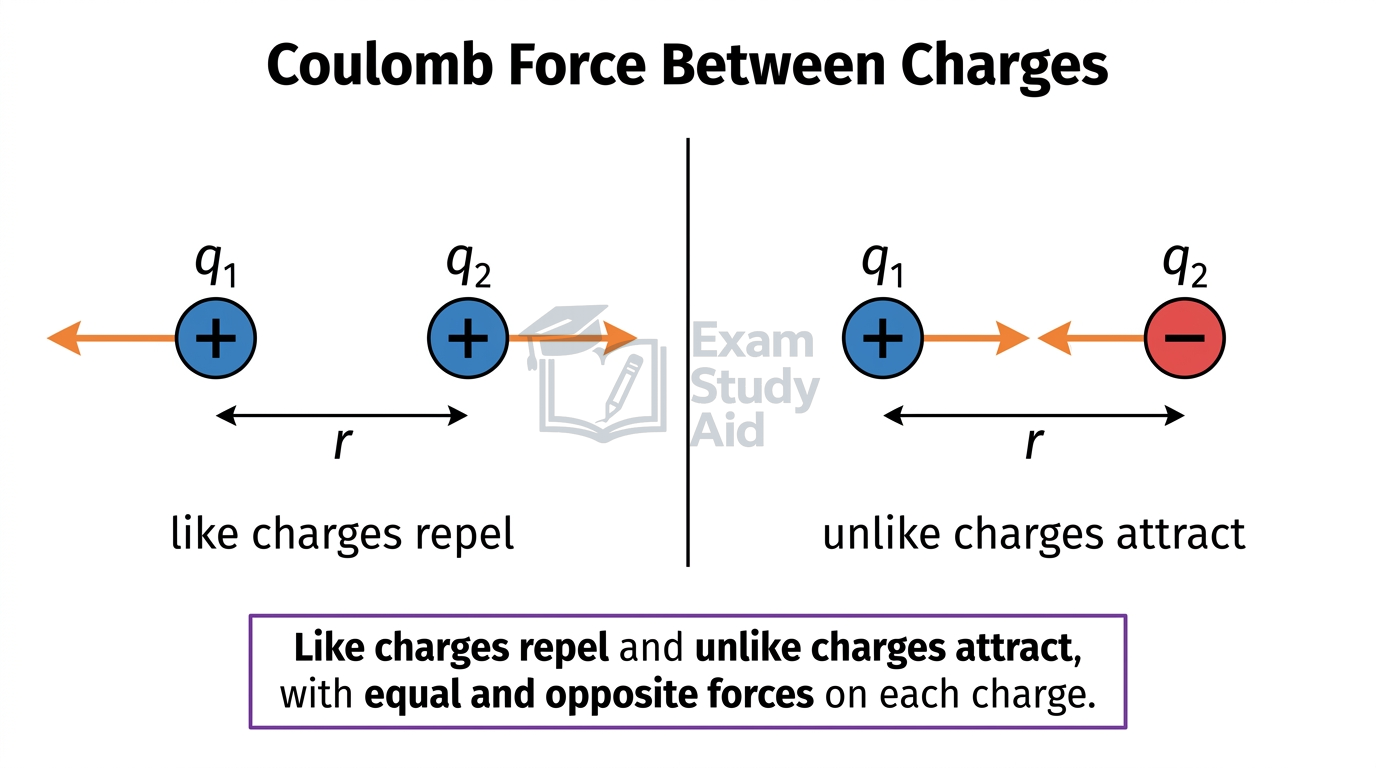
The absolute value signs on the charges give the magnitude of the force. The direction is determined separately by the signs of the charges. Two charges of the same sign repel. Two charges of opposite sign attract. The force always acts along the line connecting the two charges.
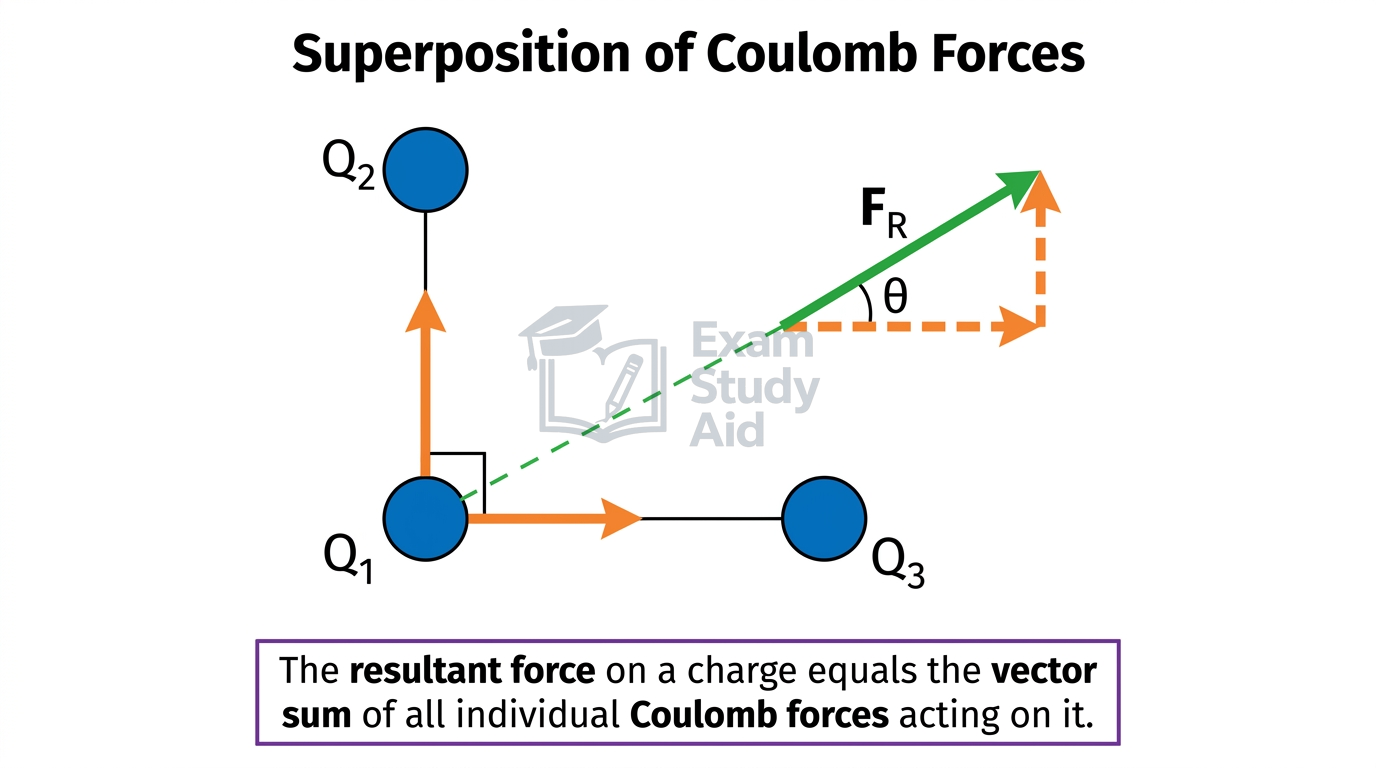
When more than two charges are present, the net force on any one charge is the vector sum of the individual Coulomb forces from every other charge. This is the superposition principle. Each pair-wise force is calculated independently, then all forces are added as vectors.
Examiner InsightFRQs often place three charges along a line and ask for the net force on one of them. Students lose points by forgetting to assign directions before adding forces.
Exam TipChoose a positive direction, find each force magnitude with Coulomb's law, then assign + or − based on direction before summing.
BoundaryAP Physics C: E&M expects calculations of electric force between four or fewer interacting charged objects. More charges are permitted only in cases of high symmetry.
This is outside the scope of the AP exam.
Worked Example: Net Force on a Charge in a Line
Three point charges sit along the x-axis. Charge ${q}_{A}=+3.0 \mu \text{C}$ is at $x=0$, charge ${q}_{B}=-2.0 \mu \text{C}$ is at $x=0.40 \text{m}$, and charge ${q}_{C}=+4.0 \mu \text{C}$ is at $x=1.0 \text{m}$. Determine the net electrostatic force on ${q}_{B}$.
Convert charges to SI:
$${q}_{A}=3.0\times {10}^{-6}\text{ C}$$
$${q}_{B}=2.0\times {10}^{-6}\text{ C}$$
$${q}_{C}=4.0\times {10}^{-6}\text{ C}$$
Choose the positive x-direction as positive.
Force on ${q}_{B}$ due to ${q}_{A}$:
${q}_{A}$ is positive and ${q}_{B}$ is negative, so the force on ${q}_{B}$ is attractive — directed toward ${q}_{A}$, in the −x direction.
Distance: ${r}_{AB}=0.40$ m.
$${F}_{AB}=\frac{k∥{q}_{A}∥∥{q}_{B}∥}{{r}_{AB}^{2}}$$
$${F}_{AB}=\frac{(8.99\times {10}^{9})(3.0\times {10}^{-6})(2.0\times {10}^{-6})}{(0.40{)}^{2}}$$
$${F}_{AB}=\frac{5.394\times {10}^{-2}}{0.16}$$
$${F}_{AB}=0.337\text{ N}$$
Direction: −x, so ${F}_{AB,x}=-0.337$ N.
Force on ${q}_{B}$ due to ${q}_{C}$:
${q}_{C}$ is positive and ${q}_{B}$ is negative, so the force is attractive — directed toward ${q}_{C}$, in the +x direction.
Distance: ${r}_{BC}=1.0-0.40=0.60$ m.
$${F}_{BC}=\frac{k∥{q}_{B}∥∥{q}_{C}∥}{{r}_{BC}^{2}}$$
$${F}_{BC}=\frac{(8.99\times {10}^{9})(2.0\times {10}^{-6})(4.0\times {10}^{-6})}{(0.60{)}^{2}}$$
$${F}_{BC}=\frac{7.192\times {10}^{-2}}{0.36}$$
$${F}_{BC}=0.200\text{ N}$$
Direction: +x, so ${F}_{BC,x}=+0.200$ N.
Net force:
$${F}_{\text{net}}={F}_{AB,x}+{F}_{BC,x}=-0.337+0.200$$
$${F}_{\text{net}}=-0.137\text{ N}$$
$${F}_{\text{net}}\approx 0.137\text{ N in the }-x\text{ direction}$$
The net force on ${q}_{B}$ points toward ${q}_{A}$. The attractive pull from ${q}_{A}$ is stronger than the pull from ${q}_{C}$ because ${q}_{A}$ is closer, and Coulomb's law depends on $1/{r}^{2}$.
Direction and Superposition of Electric Forces
The direction of the electrostatic force depends on the signs of both charges and always lies along the line connecting them.
| Charge signs | Force type | Direction |
|---|---|---|
| Same (+/+ or −/−) | Repulsive | Away from the other charge |
| Opposite (+/− or −/+) | Attractive | Toward the other charge |
Coulomb's law obeys Newton's third law. The force that ${q}_{1}$ exerts on ${q}_{2}$ is equal in magnitude and opposite in direction to the force that ${q}_{2}$ exerts on ${q}_{1}$.
When three or more charges are present, the net force on any charge equals the vector sum of all individual Coulomb forces acting on it. This is the superposition principle. Each force is calculated as if the other charges do not exist. Then all forces are added as vectors using components.
Reading vector notation: The symbol $\vec{F}$ means a vector — it has both magnitude and direction. When resolving into components along an axis, use plain ${F}_{x}$ or ${F}_{y}$ for the signed component along that axis.
Macroscopic Effects of Electric Forces
Electric forces are responsible for many macroscopic properties of everyday objects. Normal forces, friction, tension, and spring forces all arise from electrostatic interactions between atoms at contact surfaces.
At the atomic level, electrons in one surface repel electrons in another surface. These interactions produce the forces we experience as pushes, pulls, and resistance to compression. Because ordinary matter contains enormous numbers of charges, it is more convenient to describe these effects using nonfundamental contact forces rather than calculating trillions of individual Coulomb interactions.
This means every contact force studied in mechanics — normal force, friction, tension — is fundamentally electromagnetic in origin. Gravity is the exception: it arises from mass, not charge.
Examiner InsightThe AP exam may ask students to identify which fundamental force is responsible for a macroscopic interaction. Normal force, friction, and tension are all electromagnetic. Only weight is gravitational.
Exam TipIf the question asks about the "fundamental" force behind friction, the answer is the electromagnetic (electrostatic) force.
Comparing Electric and Gravitational Forces
Two objects that have both mass and charge interact through both the gravitational force and the electrostatic force. Comparing these two forces reveals important differences.
| Feature | Gravitational force | Electrostatic force | ||||
|---|---|---|---|---|---|---|
| Source property | Mass | Charge | ||||
| Direction | Always attractive | Attractive or repulsive | ||||
| Relative strength | Much weaker | Much stronger | ||||
| Dominates at | Large (astronomical) scales | Small (atomic and molecular) scales | ||||
| Proportionality | $∝\frac{{m}_{1}{m}_{2}}{{r}^{2}}$ | $∝\frac{\vert{q}_{1}\vert\vert{q}_{2}\vert}{{r}^{2}}$ |
Both forces follow an inverse-square law. Both act along the line connecting the two objects. However, for any pair of charged objects with mass, the electrostatic force is enormously larger than the gravitational force.
So why does gravity dominate at large scales? Large objects — planets, stars, galaxies — tend to be electrically neutral. Positive and negative charges cancel almost perfectly. With no net charge, there is no net electrostatic force. Mass, however, is always positive and cannot cancel. So gravity accumulates without limit as mass increases.
MisconceptionStudents sometimes think gravity is a strong force. It is by far the weakest of the fundamental forces. It only dominates at large scales because matter is nearly always electrically neutral.
Exam TipWhen comparing ${F}_{E}$ and ${F}_{g}$ between two particles, calculate both and show the ratio to demonstrate that ${F}_{E}≫{F}_{g}$.
Worked Example: Ratio of Electric to Gravitational Force Between Two Protons
Two protons are separated by 1.0 × 10⁻¹⁰ m. Calculate the ratio of the electrostatic force to the gravitational force between them.
Electrostatic force:
$${F}_{E}=\frac{k{e}^{2}}{{r}^{2}}$$
$${F}_{E}=\frac{(8.99\times {10}^{9})(1.60\times {10}^{-19}{)}^{2}}{(1.0\times {10}^{-10}{)}^{2}}$$
$${F}_{E}=\frac{(8.99\times {10}^{9})(2.56\times {10}^{-38})}{1.0\times {10}^{-20}}$$
$${F}_{E}=2.30\times {10}^{-8}\text{ N}$$
Gravitational force:
$${F}_{g}=\frac{G{m}_{p}^{2}}{{r}^{2}}$$
$${F}_{g}=\frac{(6.67\times {10}^{-11})(1.67\times {10}^{-27}{)}^{2}}{(1.0\times {10}^{-10}{)}^{2}}$$
$${F}_{g}=\frac{(6.67\times {10}^{-11})(2.789\times {10}^{-54})}{1.0\times {10}^{-20}}$$
$${F}_{g}=1.86\times {10}^{-44}\text{ N}$$
Ratio:
$$\frac{{F}_{E}}{{F}_{g}}=\frac{2.30\times {10}^{-8}}{1.86\times {10}^{-44}}\approx 1.24\times {10}^{36}$$
The electrostatic force between two protons is roughly 10³⁶ times stronger than the gravitational force. This ratio is independent of the separation distance because both forces scale as $1/{r}^{2}$.
Electric Permittivity
Electric permittivity measures how strongly a material becomes polarized when an external electric field is present. It describes how easily the charge distribution inside a material rearranges in response to a field.
Free space (vacuum) has a constant permittivity:
$${\epsilon }_{0}=8.85\times {10}^{-12}{\text{ C}}^{2}/({\text{N}\cdot\text{m}}^{2})$$
This value appears in Coulomb's law as the ${\epsilon }_{0}$ in $\frac{1}{4\pi {\epsilon }_{0}}$. A larger permittivity means the material reduces the net electric force between charges embedded in it.
Electric polarization can be modeled as the induced rearrangement of electrons by an external electric field. When a neutral material sits in an external field, its electrons shift slightly — negative charge moves toward the positive side of the field, positive charge stays behind. This creates a small internal field that partially opposes the external field.
The permittivity of matter differs from that of free space. The ease with which electrons can rearrange determines the material's permittivity.
| Material type | Charge carriers | Permittivity relative to ${\epsilon }_{0}$ |
|---|---|---|
| Conductor | Charge carriers move easily | Much larger than ${\epsilon }_{0}$ |
| Insulator | Charge carriers cannot move easily | Slightly larger than ${\epsilon }_{0}$ |
| Vacuum (free space) | No material present | Exactly ${\epsilon }_{0}$ |
In a conductor, free electrons redistribute very quickly when an external field is applied. In an insulator, electrons are bound to atoms and can only shift slightly — they cannot flow freely through the material.
Examiner InsightThe AP exam may ask why placing a dielectric (insulator) between capacitor plates changes the capacitance. The answer connects to permittivity: the dielectric's permittivity $\epsilon {\epsilon }_{0}$ reduces the internal field.
Exam TipWhenever permittivity appears, remember that larger $\epsilon $ means a weaker net field and a weaker force between charges inside the material.
| Feature | Conductor | Insulator |
|---|---|---|
| Charge carrier mobility | Move easily | Cannot move easily |
| Response to external field | Charges redistribute throughout | Charges shift slightly (polarize) |
| Example | Copper, aluminum | Glass, rubber |
QUICK RECAP
Key Points
- Charge is a scalar quantity: positive, negative, or zero.
- Elementary charge: e = 1.60 × 10⁻¹⁹ C (smallest indivisible charge).
- Proton charge = +e; electron charge = −e; neutron charge = 0.
- A point charge is a model where the object's size is negligible.
- Coulomb's law: ${F}_{E}=k{q}_{1}{q}_{2}/{r}^{2}$; inverse-square law.
- Force is directly proportional to each charge magnitude.
- Doubling distance reduces force to one quarter (inverse-square).
- Like charges repel; opposite charges attract.
- Force direction is always along the line connecting the charges.
- Superposition: net force = vector sum of all individual Coulomb forces.
- Contact forces (normal, friction, tension) are electromagnetic in origin.
- Electrostatic force is ~10³⁶ times stronger than gravity for protons.
- Gravity dominates large scales because large objects are electrically neutral.
- Permittivity ε₀ = 8.85 × 10⁻¹² C²/(N·m²) for free space.
- Greater permittivity means weaker net field and weaker force.
- Conductors: charge carriers move easily. Insulators: they cannot.
- Polarization = induced rearrangement of electrons by an external field.
CAN I...? PROGRESS CHECK
Self-Assessment
- Can I state the properties of charge (scalar, quantized, two signs)?
- Can I calculate the electrostatic force between two or three point charges using Coulomb's law, including vector addition?
- Can I determine the direction of the net force on a charge due to multiple other charges using superposition?
- Can I derive the ratio ${F}_{E}/{F}_{g}$ for a pair of charged particles and explain why it is distance-independent?
- Can I explain why gravity dominates at large scales despite being the weaker force?
- Can I describe electric permittivity and distinguish conductors from insulators based on charge carrier mobility?
- Can I predict whether placing a dielectric between charges increases or decreases the electrostatic force?