
Learning Objectives
1 objectiveBy the end of this note, you should be able to:
- 1.1.ADescribe a scalar or vector quantity using magnitude and direction, as appropriate.
Scalars, Vectors, and Why the Difference Matters
Every measurable quantity in physics is either a scalar or a vector, and the distinction shapes how calculations work throughout the entire course.
A scalar is a quantity described by magnitude only. Magnitude means a number with a unit — nothing more. Temperature, mass, energy, time, distance, and speed are all scalars. Saying “the car travels at 25 m/s” gives complete scalar information.
A vector is a quantity described by both magnitude and direction. Position, displacement, velocity, and acceleration are all vectors. Saying “the car moves at 25 m/s” is incomplete as a vector statement. You must also say which way — for example, “25 m/s east.”
Because vectors carry direction, two vectors of equal magnitude can produce very different physical outcomes if they point differently. Two 10 N forces pushing the same way produce 20 N total. The same two forces pushing in opposite directions produce 0 N total. Scalars never behave this way — 10 J plus 10 J is always 20 J.
| Feature | Scalar | Vector |
|---|---|---|
| Described by | Magnitude only | Magnitude and direction |
| Examples | Distance, speed, mass, energy, time | Displacement, velocity, acceleration, force |
| Addition rule | Ordinary arithmetic | Component-wise or tip-to-tail |
| Can be negative? | Only if a sign represents a physical decrease (e.g., −ΔU) | Yes — sign indicates direction along a chosen axis |
MisconceptionStudents often treat speed and velocity as the same thing. Speed is always positive (scalar). Velocity carries a sign indicating direction (vector).
Exam TipOn FRQs, always specify direction when reporting a vector answer.
Visual Representation of Vectors
Vectors can be visually modeled as arrows, and reading these arrows correctly is a skill used in every unit that follows.
Here is how to read a vector arrow:
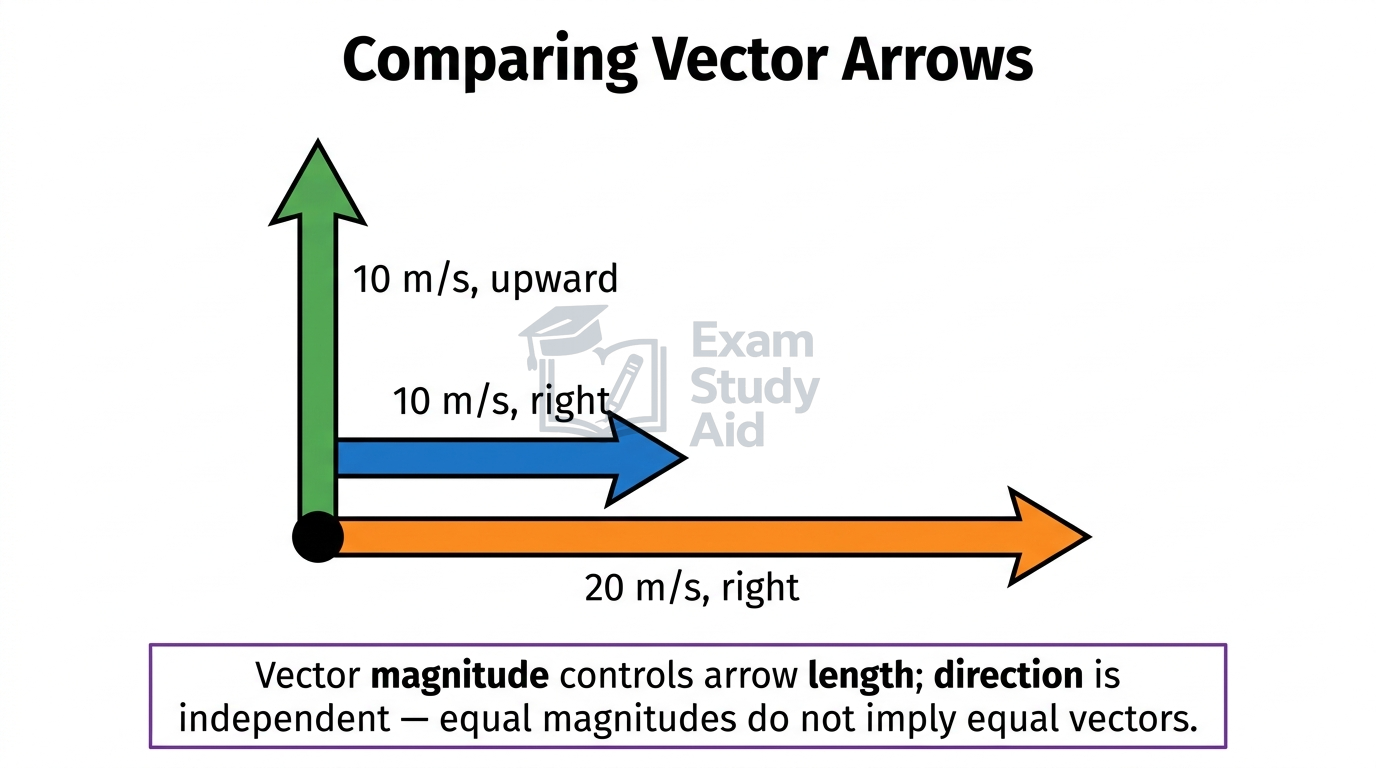
- The length of the arrow is proportional to the vector’s magnitude. A longer arrow means a larger value.
- The direction the arrow points shows the direction of the quantity.
- The tail is where the vector starts; the tip (arrowhead) is where it ends.
When two or more vector arrows are drawn on the same diagram, their lengths can be compared directly. An arrow twice as long represents a vector twice as large in magnitude. This proportionality must be respected when sketching vectors in exam diagrams.
Unit Vector Notation
Vectors can be expressed in two equivalent ways: as a magnitude with a direction, or in unit vector notation. Both carry the same information, but unit vector notation is the standard language for calculations in AP Physics C.
A unit vector is a dimensionless vector with magnitude 1 that points along a coordinate axis. The three standard unit vectors are:
- î — points in the +x direction
- ĵ — points in the +y direction
- k̂ — points in the +z direction
Any vector can be written as the sum of its components along these axes. For example, a velocity vector with an x-component of 3 m/s and a y-component of 4 m/s is written:
$$\vec{v}=3\hat{i}+4\hat{j}\text{ m/s}$$
The notation works by multiplying each unit vector by the component’s value. A negative component simply means that part of the vector points in the negative axis direction. So $\vec{F}=-5\hat{i}+2\hat{j}$ N describes a force with 5 N in the −x direction and 2 N in the +y direction.
The position vector $\vec{r}$ points from the origin to a point in space:
$$\vec{r}=x\hat{i}+y\hat{j}+z\hat{k}$$
The unit position vector $\hat{r}$ points in the same direction as $\vec{r}$ but has magnitude 1. It is found by dividing $\vec{r}$ by its magnitude:
$$\hat{r}=\frac{\vec{r}}{∥\vec{r}∥}$$
This unit vector $\hat{r}$ appears frequently in gravitational and electric field equations. It tells you the direction from one object to another without carrying any magnitude information.
Examiner InsightFRQs in AP Physics C often give or expect answers in unit vector notation. Practice converting between magnitude-and-angle form and î, ĵ form.
Exam TipAlways include the unit vectors when writing component-form answers.
Resultant Vectors from Components
A resultant vector is the vector sum of two or more vectors, found by adding their components independently along each axis.
Given two vectors $\vec{A}={A}_{x}\hat{i}+{A}_{y}\hat{j}$ and $\vec{B}={B}_{x}\hat{i}+{B}_{y}\hat{j}$, the resultant is:
$$\vec{R}=({A}_{x}+{B}_{x})\hat{i}+({A}_{y}+{B}_{y})\hat{j}$$
Each direction is handled separately. The x-components add together, and the y-components add together. This is why unit vector notation is so powerful — it turns vector addition into simple arithmetic along each axis.
The magnitude of the resultant is found using the Pythagorean theorem:
Key Equations
Magnitude of a 2D resultant vector:
$$∥\vec{R}∥=\sqrt{{R}_{x}^{2}+{R}_{y}^{2}}$$
Variables:
- ${R}_{x}$ = x-component of the resultant (m, N, m/s, etc.)
- ${R}_{y}$ = y-component of the resultant (m, N, m/s, etc.)
SI unit: same as the component units
Direction of the resultant:
$$\theta ={tan}^{-1}\left(\frac{{R}_{y}}{{R}_{x}}\right)$$
Variables:
- $\theta $ = angle measured from the +x axis (degrees or radians)
Reference sheet status: These are foundational relationships — know them by heart.
The angle $\theta $ gives the direction measured counterclockwise from the positive x-axis. Always check the quadrant — the inverse tangent function only returns values in two quadrants, so adjust based on the signs of ${R}_{x}$ and ${R}_{y}$.
Worked Example: Adding Two Displacement Vectors
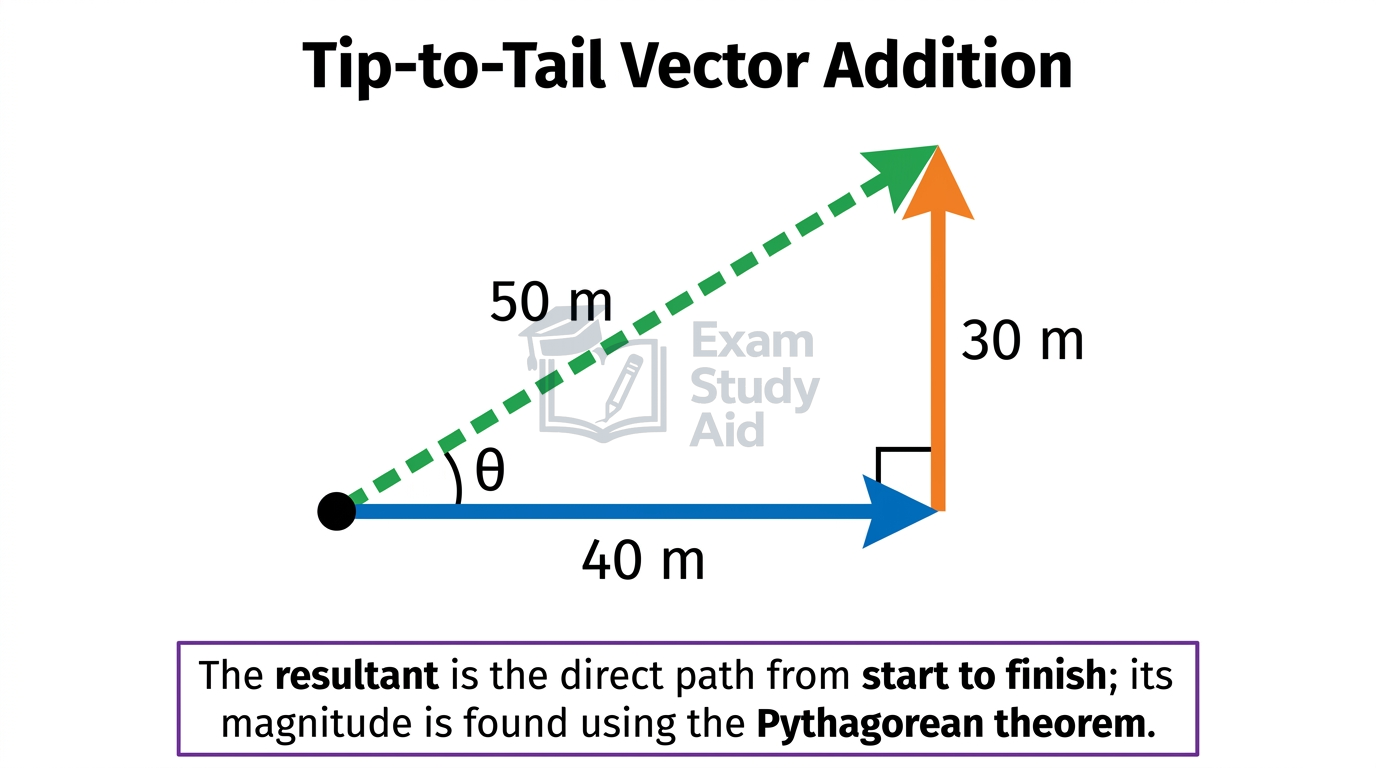
A hiker walks 40 m east and then 30 m north. Determine the resultant displacement as a magnitude and a direction.
Step-by-step solution:
Define the positive x-direction as east and the positive y-direction as north.
Express each displacement in component form:
$${\vec{d}}_{1}=40\hat{i}\text{ m}$$
$${\vec{d}}_{2}=30\hat{j}\text{ m}$$
Add components to find the resultant:
$$\vec{R}=40\hat{i}+30\hat{j}\text{ m}$$
Find the magnitude:
$$∥\vec{R}∥=\sqrt{{40}^{2}+{30}^{2}}$$
$$∥\vec{R}∥=\sqrt{1600+900}$$
$$∥\vec{R}∥=\sqrt{2500}=50\text{ m}$$
Find the direction:
$$\theta ={tan}^{-1}\left(\frac{30}{40}\right)$$
$$\theta ={tan}^{-1}(0.75)=36.9^{\circ}$$
The angle is measured from the +x axis (east), and both components are positive. This places the resultant in the first quadrant.
$$\vec{R}=50\text{ m at }36.9^{\circ}\text{ north of east}$$
The hiker ends up 50 m from the starting point, in a direction 36.9° north of east. The resultant displacement (50 m) is less than the total distance walked (70 m) because displacement is a vector and distance is a scalar.
Sign Conventions in One Dimension
In a one-dimensional coordinate system, direction is represented by algebraic sign rather than by arrows or compass headings.
Choose a positive direction — for example, rightward or upward. Every vector pointing in that direction gets a positive value. Every vector pointing the opposite way gets a negative value. This convention must be stated before any calculation begins.
A velocity of $v=-4$ m/s does not mean “negative speed.” It means 4 m/s in the direction opposite to the chosen positive direction. The magnitude (speed) is still 4 m/s. Only the sign carries directional information.
This same rule applies to all one-dimensional vector quantities: position, displacement, velocity, acceleration, and force. Consistency is essential — once you choose a positive direction, every vector in the problem must follow that choice.
MisconceptionA negative velocity does not mean “slowing down.” It means moving in the negative direction. An object can have negative velocity and be speeding up if its acceleration is also negative.
Exam TipAlways define your positive direction at the start of a problem.
QUICK RECAP
Key Points
- Scalars have magnitude only; vectors have magnitude and direction.
- Distance and speed are scalars; displacement, velocity, and acceleration are vectors.
- Vector arrows have length proportional to magnitude and point in the vector’s direction.
- î, ĵ, and k̂ are unit vectors along the +x, +y, and +z axes.
- Any vector can be written as the sum of its components times the unit vectors.
- The position vector r⃗ points from the origin to a point in space.
- The unit position vector r̂ equals r⃗ divided by its magnitude.
- Resultant vectors are found by adding components along each axis separately.
- Magnitude of a 2D resultant: $∥\vec{R}∥=\sqrt{{R}_{x}^{2}+{R}_{y}^{2}}$.
- Direction of a resultant: $\theta ={tan}^{-1}({R}_{y}/{R}_{x})$, adjusted for quadrant.
- In one dimension, opposite directions are shown by opposite signs.
- A negative velocity means motion in the negative direction, not slowing down.
- Always define the positive direction before starting a vector calculation.
CAN I…? PROGRESS CHECK
Self-Assessment
- Can I classify any physical quantity as scalar or vector and justify the classification?
- Can I express a vector in unit vector notation given its components?
- Can I calculate the magnitude and direction of a resultant vector from its components?
- Can I add two or more vectors by summing their î and ĵ components independently?
- Can I correctly assign positive and negative signs to vectors in a one-dimensional problem?
- Can I distinguish between distance and displacement, and between speed and velocity, in a physical scenario?