
Learning Objectives
2 objectivesBy the end of this note, you should be able to:
- Understand that all living organisms share eight key life characteristics.
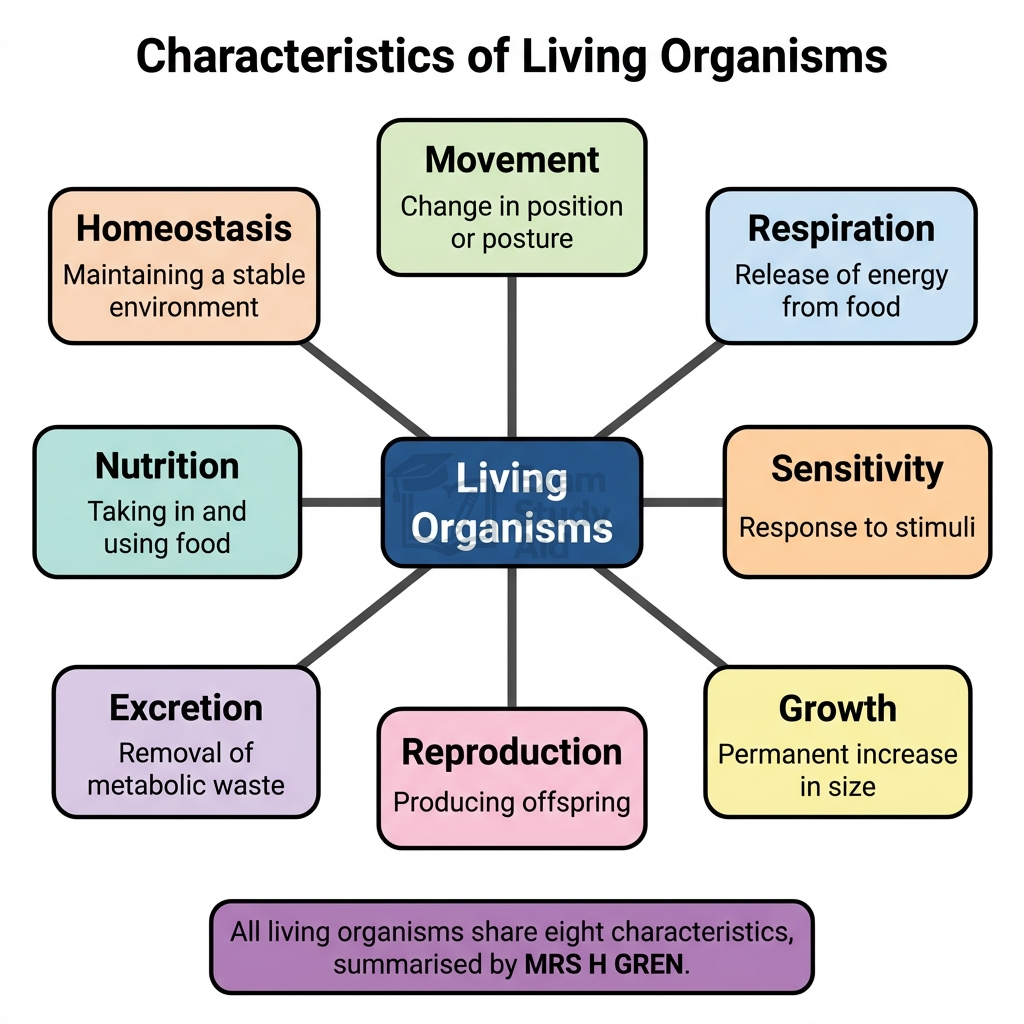
- Recall each characteristic: nutrition, respiration, excretion, sensitivity, movement, homeostasis, reproduction, growth and development.
The Eight Characteristics of Life
All living organisms, no matter how simple or complex, share eight characteristics of life that distinguish them from non-living things. A organism must display all eight to be considered truly alive — showing just one or two is not enough. For example, a crystal can grow, and fire can move, but neither carries out all eight processes.
These characteristics apply equally to a single-celled organism such as an amoeba and to a complex multicellular organism such as a human. Each characteristic reflects a fundamental biological process that keeps the organism alive or allows it to pass on its genes.
| Characteristic | Meaning |
|---|---|
| Nutrition | Taking in and absorbing nutrients (materials and energy) needed for growth and energy release |
| Respiration | Chemical reactions in cells that break down nutrient molecules to release energy for life processes |
| Excretion | Removal of toxic waste products of metabolism from the body |
| Sensitivity (response) | Detecting and responding to changes in the surroundings (stimuli) |
| Movement | An action by an organism or part of an organism that causes a change of position or place |
| Homeostasis | Controlling internal conditions to maintain a stable internal environment |
| Reproduction | Producing offspring, either sexually or asexually, to continue the species |
| Growth and development | A permanent increase in size and an increase in complexity as the organism matures |
Because respiration happens inside cells, it occurs in every living organism — even plants. Excretion is specifically the removal of metabolic waste (such as carbon dioxide or urea), so it should not be confused with egestion, which is the removal of undigested food. Homeostasis keeps factors like temperature and water balance within narrow limits, which is essential because enzymes and cells only function properly under stable conditions.
MisconceptionStudents often confuse excretion with egestion. Excretion removes waste products made by chemical reactions in cells (metabolism), such as CO₂ from respiration. Egestion removes undigested food that was never absorbed into cells, so it is not excretion.
Exam TipIf a question asks for an example of excretion, choose CO₂ or urea — never faeces.
Examiner InsightExaminers frequently ask students to explain why something like fire or a virus is not alive. The key is to identify which of the eight characteristics are missing. Viruses, for instance, cannot reproduce on their own and do not respire or grow.
Exam TipAlways refer back to the full set of eight characteristics when justifying whether something is alive.
MnemonicMRS GREN H — Movement, Respiration, Sensitivity, Growth, Reproduction, Excretion, Nutrition, Homeostasis.
QUICK RECAP
Key Points
- Living organisms share eight key characteristics.
- Nutrition means taking in materials for energy and growth.
- Respiration releases energy from nutrients inside cells.
- Excretion removes metabolic waste, not undigested food.
- Sensitivity is detecting and responding to stimuli.
- Movement is a change of position by the organism.
- Homeostasis maintains stable internal conditions.
- Reproduction produces new individuals of the same species.
- Growth is a permanent increase in size; development increases complexity.
- All eight must be present to classify something as living.
- MRS GREN H helps recall all eight characteristics.
CAN I…? PROGRESS CHECK
Self-Assessment
- List all eight characteristics of living organisms from memory?
- Define excretion and explain how it differs from egestion?
- Explain why something like fire or a virus is not truly alive?
- State what homeostasis means and why it matters for organisms?
- Give a correct example of excretion in a named organism?