
Learning Objectives
7 objectivesBy the end of this note, you should be able to:
- Understand the three states of matter in terms of arrangement, movement, and energy of particles
- Understand interconversions between states: names, how achieved, and particle changes
- Understand how dilution of coloured solutions and diffusion of gases are explained
- Know the terms solvent, solute, solution, and saturated solution
- Know the meaning of solubility in units g per 100 g of solvent
- Understand how to plot and interpret solubility curves
- Practical: investigate the solubility of a solid in water at a specific temperature
The Three States of Matter
All substances exist as solids, liquids, or gases, and the differences between these three states depend entirely on how their particles are arranged, how they move, and how much energy they possess.
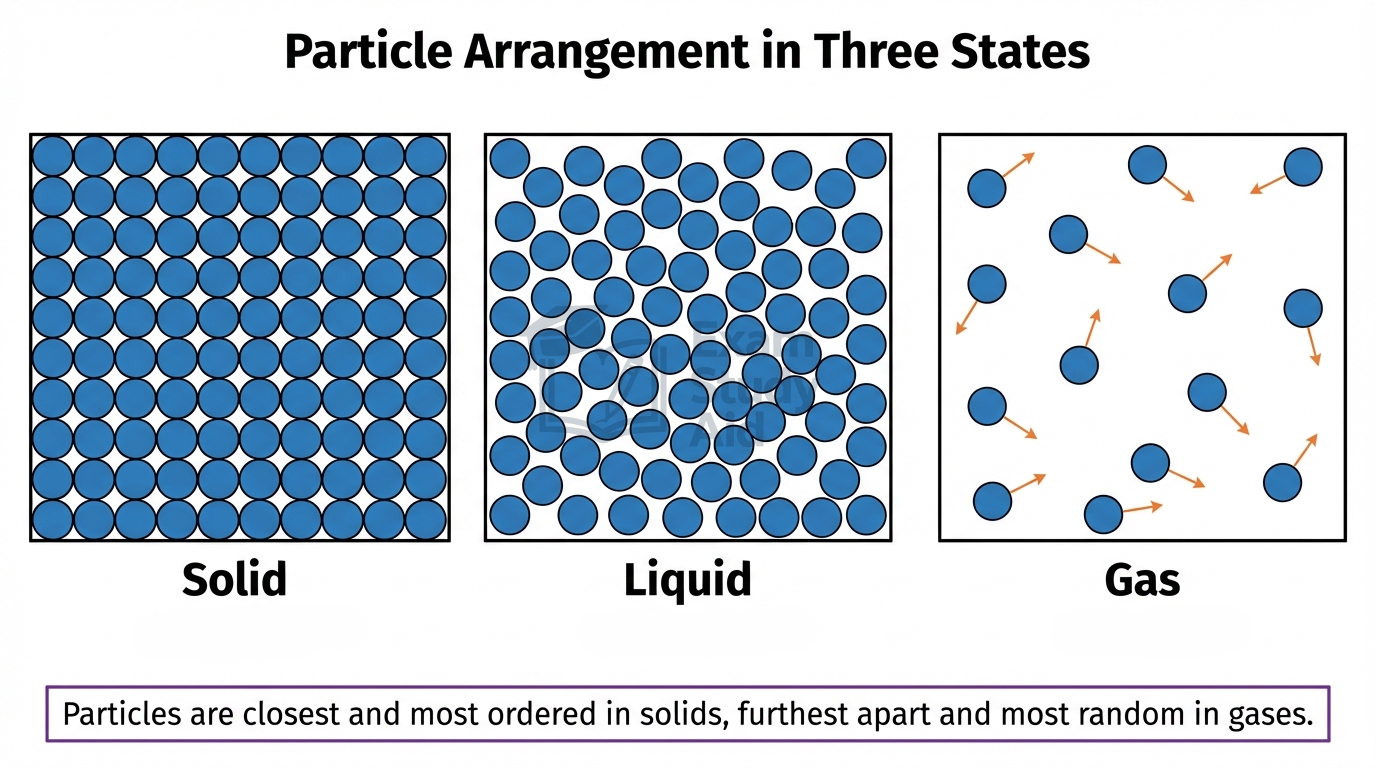
In a solid, particles are held in fixed positions within a regular, closely packed arrangement. They vibrate about these fixed positions but cannot move from place to place, because strong forces of attraction hold them together. Solids therefore have a definite shape and a definite volume. The particles possess the least kinetic energy of the three states.
In a liquid, particles are still close together but no longer arranged in a regular pattern. They can slide over one another, which means liquids flow and take the shape of their container. The particles have more kinetic energy than in a solid, so they move more freely, but the forces between them are still strong enough to keep them close together. Liquids have a definite volume but no fixed shape.
In a gas, particles are far apart with no regular arrangement. They move rapidly in all directions with random motion. The forces between particles are negligible, so gases spread out to fill any container. Gas particles possess the most kinetic energy of the three states, which is why they move at high speeds. Gases have no fixed shape and no fixed volume.
MisconceptionParticles themselves do not expand, melt, or change size when heated. Only the arrangement, spacing, and movement of particles change between states. The particles remain identical in size throughout.
Exam TipNever write "particles get bigger" — write "particles move further apart" or "particles gain energy."
Interconversions Between States
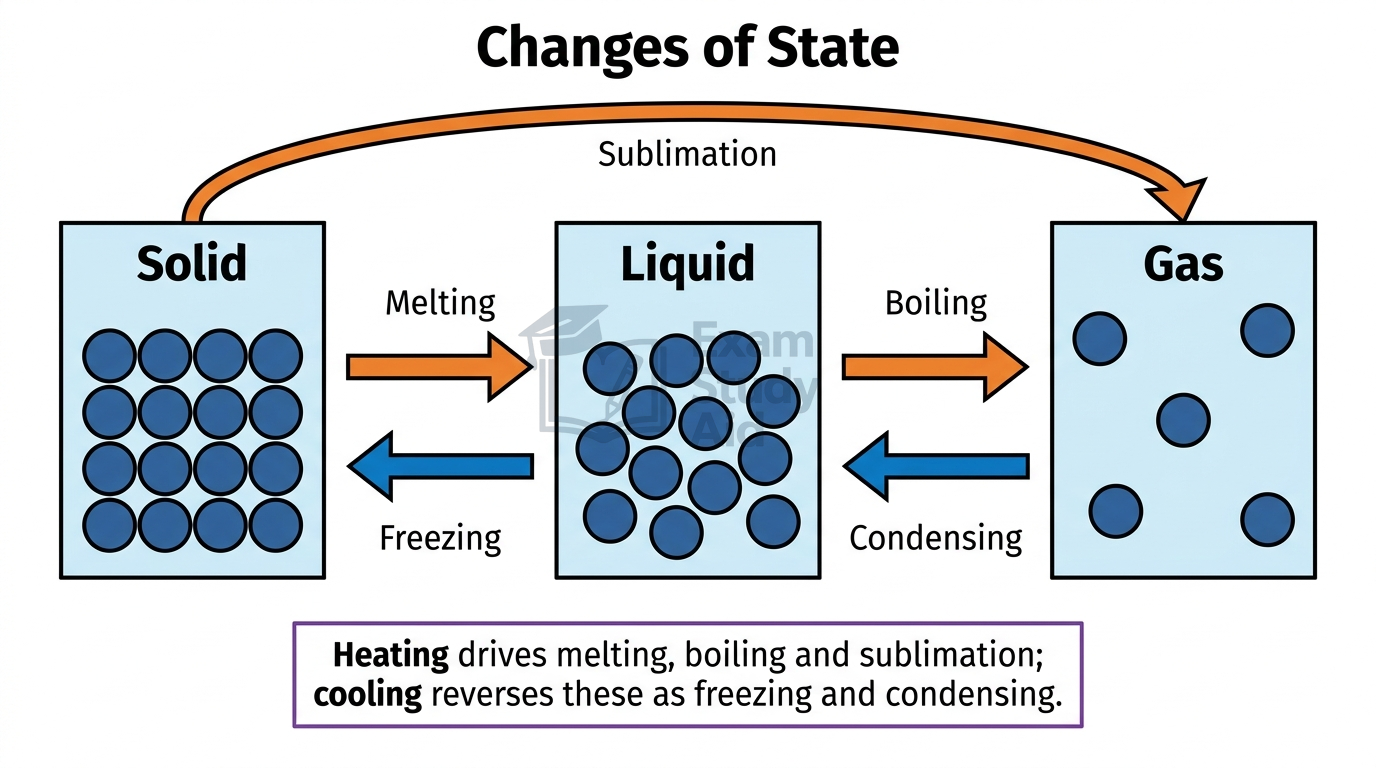
The interconversions between the three states of matter have specific names, each caused by heating or cooling a substance to change the energy of its particles.
Melting converts a solid into a liquid. Heating a solid increases the kinetic energy of its particles until they vibrate enough to break free from their fixed positions. The regular arrangement is lost, and particles begin to slide over one another.
Boiling (or evaporation) converts a liquid into a gas. Continued heating increases particle energy further until the forces between particles are overcome entirely. Particles escape into the gas phase, moving rapidly and randomly with large spaces between them.
Condensing converts a gas into a liquid. Cooling a gas decreases the kinetic energy of particles, so they slow down. The forces of attraction pull them closer together into an irregular, close arrangement.
Freezing converts a liquid into a solid. Further cooling reduces particle energy until the particles can no longer slide over each other. They lock into fixed positions, forming a regular arrangement.
Sublimation converts a solid directly into a gas without passing through the liquid state. This occurs when particles at the surface of a solid gain enough energy to break free completely.
Examiner InsightExam questions frequently ask for three-mark answers covering the change in arrangement, movement, and energy. Structure answers to address all three separately to secure full marks.
Exam TipUse the framework "arrangement… movement… energy…" as a mental checklist for every state-change question.
MisconceptionEvaporation and boiling are not identical. Evaporation occurs at the surface of a liquid at any temperature, while boiling occurs throughout the liquid at a specific temperature (the boiling point). Exam questions may ask students to distinguish between them.
Exam TipIf asked about evaporation, state it happens "at the surface" and "below the boiling point."
Dilution and Diffusion Experiments
Evidence for the particle model comes from experiments involving dilution of coloured solutions and diffusion of gases, both of which demonstrate that matter is made of tiny, moving particles.
When a coloured solution such as potassium manganate(VII) is diluted with water, the solution becomes paler but remains uniformly coloured throughout. This occurs because the coloured solute particles spread out evenly among the water particles. Even at high dilution, the colour persists because individual particles are far too small to see, yet millions are still present.
Diffusion [the spreading out of particles from a region of higher concentration to a region of lower concentration] provides direct evidence that gas particles move randomly and continuously. When a gas jar of bromine vapour is placed below a gas jar of air and the cover is removed, the brown bromine colour gradually spreads upward into the air jar. This happens because bromine particles move randomly in all directions and mix with the air particles over time, even against gravity. The process is slower than expected for free movement because bromine particles constantly collide with air particles, changing direction repeatedly.
Diffusion is faster at higher temperatures because particles have more kinetic energy, so they move more quickly. Lighter gas molecules diffuse faster than heavier ones because, at the same temperature, lighter particles move at greater speeds.
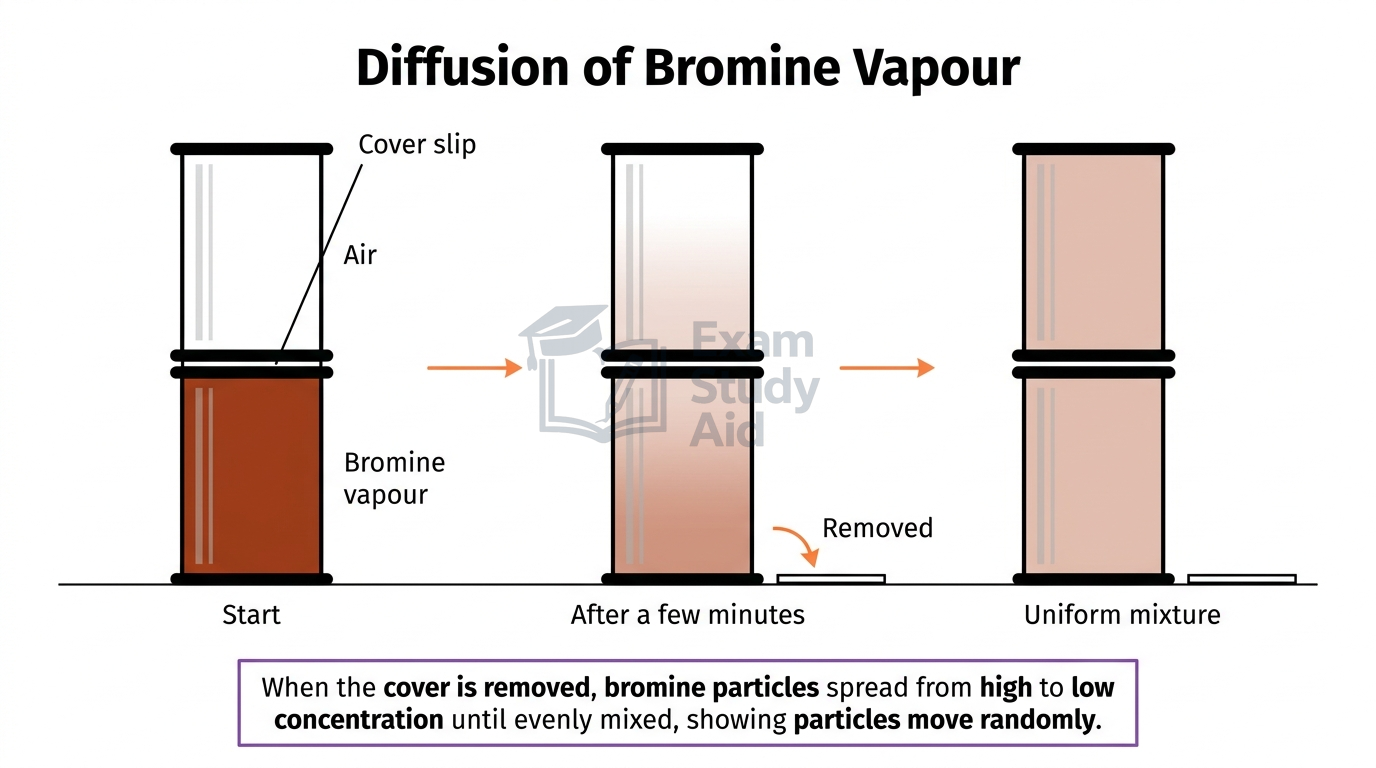
Examiner InsightA common 3-mark question provides the bromine experiment and asks students to explain the observation using particle theory. Always state: particles move randomly; particles spread from high to low concentration; process is slow because of collisions with air particles.
Exam TipUse the phrase "random motion" and refer to collisions to explain why diffusion is gradual.
Solvent, Solute, Solution, and Saturated Solution
Understanding the terms solvent, solute, solution, and saturated solution is essential for describing dissolving processes precisely.
A solvent is the liquid in which a substance dissolves. A solute is the substance that dissolves in the solvent. A solution is the mixture formed when a solute dissolves in a solvent. The solute particles spread evenly throughout the solvent, so a solution is a homogeneous [uniform throughout] mixture.
A saturated solution is one that contains the maximum amount of solute that can dissolve at that temperature. No more solute can dissolve in a saturated solution — any additional solute remains as an undissolved solid at the bottom of the container. Increasing the temperature of a saturated solution usually allows more solute to dissolve, because solubility generally increases with temperature.
MisconceptionA saturated solution is not the same as a concentrated solution. A concentrated solution simply has a large amount of solute relative to solvent, but more could still dissolve. A saturated solution cannot dissolve any more solute at that temperature.
Exam TipAlways link "saturated" to "at that temperature" — saturation depends on temperature.
Solubility
Solubility measures how much solute dissolves in a given amount of solvent at a particular temperature, expressed in the units grams per 100 g of solvent (g per 100 g of solvent).
For example, if 36 g of sodium chloride dissolves in 100 g of water at 25 °C, the solubility of sodium chloride at 25 °C is 36 g per 100 g of solvent. This unit is critical — solubility is always measured per 100 g of solvent, not per 100 g of solution. The solvent mass excludes the solute.
Solubility varies with temperature. For most solid solutes, solubility increases as temperature increases, because the additional energy helps break apart the solute structure and allows more particles to become surrounded by solvent particles.
Key Equations
Solubility: solubility = mass of solute dissolved ÷ mass of solvent × 100
Variables:
- mass of solute dissolved: the mass of solute that dissolves to form a saturated solution, in g
- mass of solvent: the mass of liquid used, in g
- The × 100 scales the result to "per 100 g of solvent"
SI unit: g per 100 g of solvent
Worked Example: Calculating Solubility
15 g of potassium nitrate dissolves in 50 g of water at 30 °C. Calculate the solubility.
Potassium nitrate, KNO₃
State the equation for solubility.
$$solubility=\frac{\text{mass of solute}}{\text{mass of solvent}}\times 100$$
Substitute the given values.
$$solubility=\frac{15}{50}\times 100$$
$$solubility=30 g per 100 \text{g of solvent}$$
MisconceptionStudents often divide by the total mass of solution (solute + solvent) instead of by the mass of solvent alone. Solubility is always expressed per 100 g of solvent, not per 100 g of solution.
Exam TipCheck that your denominator is the mass of the solvent only.
Plotting and Interpreting Solubility Curves
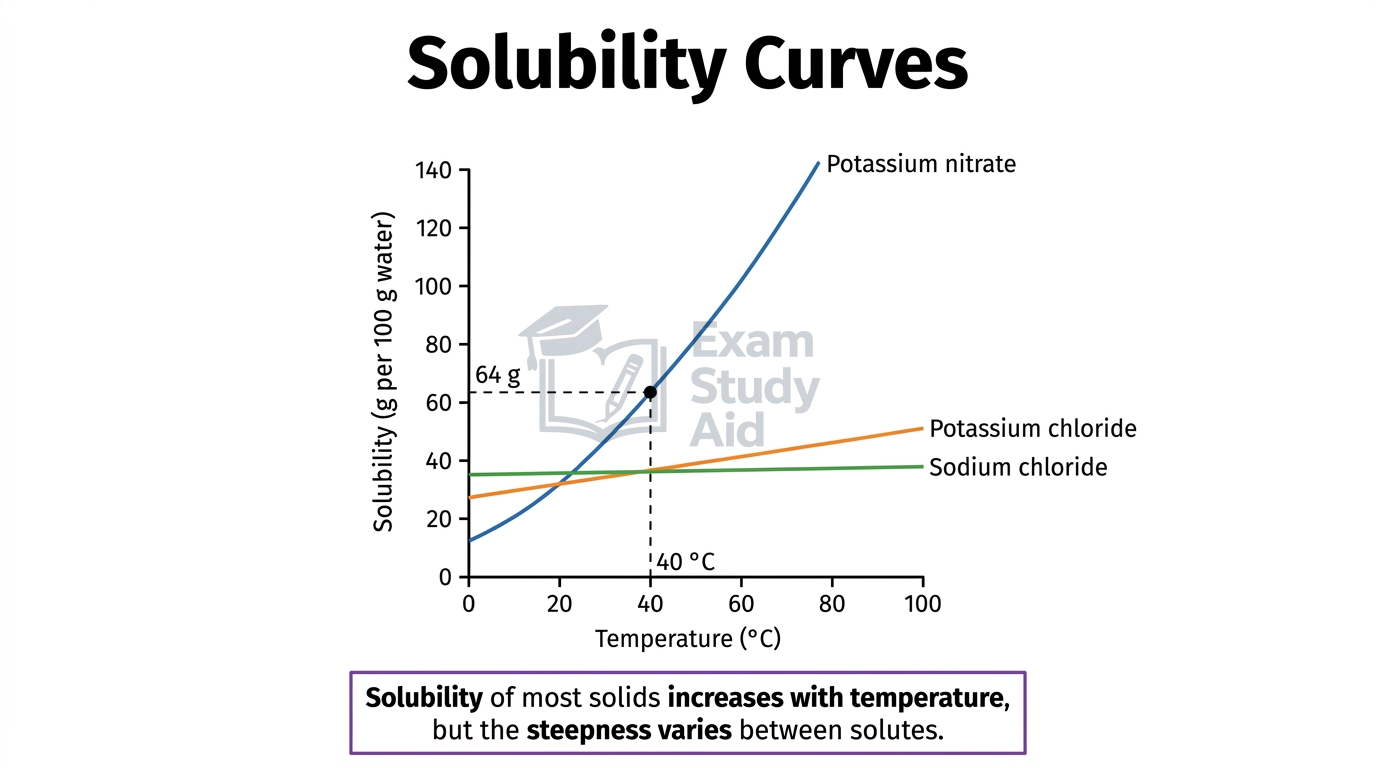
A solubility curve is a graph that shows how the solubility of a substance changes with temperature, providing a visual way to compare the solubility of different solutes and to read off values at specific temperatures.
Reading a solubility curve: the x-axis shows temperature (in °C) and the y-axis shows solubility (in g per 100 g of solvent). Each line on the graph represents one substance. To find the solubility at a given temperature, locate the temperature on the x-axis, draw a vertical line up to the curve, then draw a horizontal line across to the y-axis and read the value.
For most solid solutes, the curve slopes upward from left to right, which means solubility increases as temperature increases. A steeper curve indicates that solubility is more sensitive to temperature changes. Some substances, such as sodium chloride, have nearly flat curves, meaning their solubility changes very little with temperature.
Any point on the curve represents a saturated solution at that temperature. A point below the curve represents an unsaturated solution — more solute could still dissolve. A point above the curve is impossible under normal conditions, because that amount of solute cannot remain dissolved at that temperature. If a hot saturated solution is cooled, the solubility decreases, so excess solute crystallises out. The mass of crystals formed equals the difference in solubility between the two temperatures.
Worked Example: Reading a Solubility Curve
The solubility of potassium nitrate at 60 °C is 110 g per 100 g of solvent, and at 20 °C it is 32 g per 100 g of solvent. Calculate the mass of crystals that form when a saturated solution containing 100 g of water is cooled from 60 °C to 20 °C.
Potassium nitrate, KNO₃
Calculate the mass dissolved at 60 °C in 100 g of water.
$$\text{mass dissolved at} 60 ^{\circ}C=110 g$$
Calculate the mass dissolved at 20 °C in 100 g of water.
$$\text{mass dissolved at} 20 ^{\circ}C=32 g$$
Find the mass of crystals formed.
$$\text{mass of crystals}=110-32$$
$$\text{mass of crystals}=78 g$$
Examiner InsightExaminers frequently test whether students can use the solubility curve to calculate the mass of crystals formed on cooling. Always subtract the solubility at the lower temperature from the solubility at the higher temperature, then scale for the actual mass of solvent if it is not 100 g.
Exam TipIf the water mass is not 100 g, multiply the solubility-per-100-g value by the fraction of solvent used (e.g. for 50 g of water, halve the value).
Investigating Solubility at a Specific Temperature
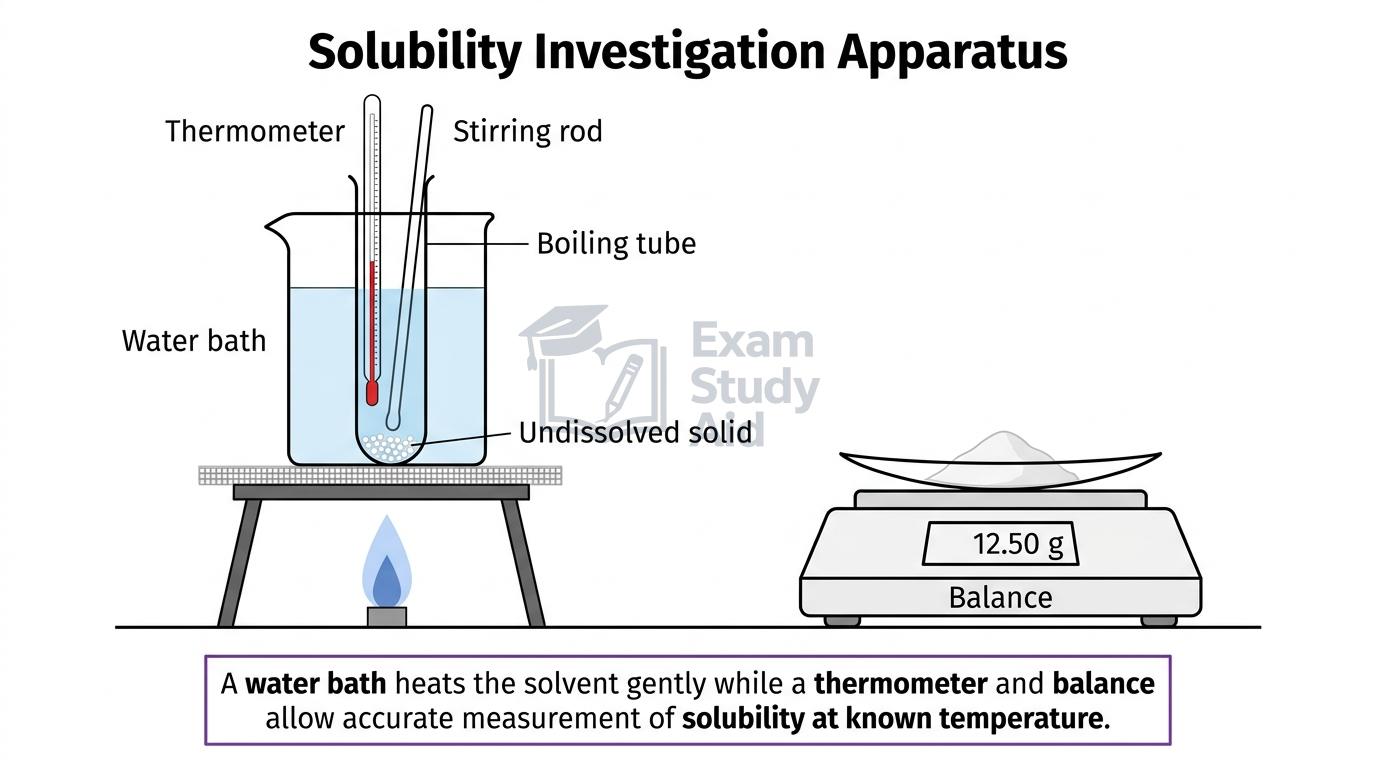
PRACTICAL: Investigating the solubility of a solid in water at a specific temperature
Aim: To determine the solubility of a named solid (e.g. potassium chloride) in water at a specific temperature, by finding the maximum mass that dissolves in a known mass of water.
1. Measure 20 cm³ (20 g) of distilled water into a boiling tube using a measuring cylinder.
2. Heat the water in a water bath set to the required temperature (e.g. 40 °C) and allow it to stabilise. Monitor using a thermometer.
3. Add small, weighed portions of the solid to the water, stirring after each addition until the solid dissolves completely.
4. Continue adding solid until no more dissolves and a small amount of undissolved solid remains at the bottom — the solution is now saturated.
5. Record the total mass of solid added before the solution became saturated (i.e. subtract the mass of the final undissolved portion).
6. Calculate the solubility using: solubility = (mass dissolved ÷ mass of water) × 100.
Independent variable (IV): The mass of solid added (in g), increased in small portions until saturation.
Dependent variable (DV): The total mass of solid that dissolves (in g), determined by recording masses before and after addition.
Control variables (CV): Temperature of the water — maintained using a water bath and checked with a thermometer; volume/mass of water — kept at 20 g using a measuring cylinder; the same solid solute used throughout.
The solid dissolves until the solution becomes saturated, at which point undissolved solid remains. The solubility value obtained should be consistent with published data for that solid at the given temperature.
The main source of error is failing to maintain a constant temperature during the experiment, which changes the solubility. Using a thermostatically controlled water bath and checking the thermometer regularly minimises this error.
SafetyHot water from the water bath can cause scalds. Handle the boiling tube with tongs and take care when stirring hot solutions.
QUICK RECAP
Key Points
- Solids: regular arrangement, particles vibrate in fixed positions, lowest energy
- Liquids: irregular, close arrangement, particles slide over each other, moderate energy
- Gases: random, far apart, rapid random movement, highest energy
- Melting and boiling require heating; condensing and freezing require cooling
- Sublimation converts a solid directly to a gas
- Diffusion is the spreading of particles from high to low concentration
- Lighter gas molecules diffuse faster than heavier ones
- A solvent is the liquid; a solute is the dissolved substance
- A saturated solution holds the maximum solute at that temperature
- Solubility is measured in g per 100 g of solvent
- Most solid solutes become more soluble as temperature increases
- Solubility curves show solubility against temperature
- Crystals form when a saturated solution is cooled below its saturation temperature
- Use a water bath to maintain constant temperature in solubility practicals
CAN I…? PROGRESS CHECK
Self-Assessment
- Describe the arrangement, movement, and energy of particles in each state of matter?
- Name all five interconversions between states and state how each is achieved?
- Explain observations from diffusion and dilution experiments using particle theory?
- Define solvent, solute, solution, and saturated solution?
- State the units of solubility and calculate solubility from experimental data?
- Read solubility values from a curve and calculate the mass of crystals formed on cooling?
- Describe the method and variables for the solubility practical?