
Learning Objectives
6 objectivesBy the end of this note, you should be able to:
- State the distinguishing properties of solids, liquids and gases.
- Describe the structures of solids, liquids and gases in terms of particle separation, arrangement and motion.
- Describe changes of state in terms of melting, boiling, evaporating, freezing and condensing.
- Describe the effects of temperature and pressure on the volume of a gas.
- Explain changes of state in terms of kinetic particle theory, including the interpretation of heating and cooling curves.
- Explain, in terms of kinetic particle theory, the effects of temperature and pressure on the volume of a gas.
CORE VS EXTENDED GUIDE
- Core students study only the unlabelled sections.
- Extended students must study everything, including Extended Extended points.
- Extended = Core + Supplement.
Properties of Solids, Liquids and Gases
The three states of matter — solid, liquid and gas — differ in shape, volume and compressibility.
| Property | Solid | Liquid | Gas |
|---|---|---|---|
| Shape | Fixed | Takes the shape of the container | Fills the container |
| Volume | Fixed | Fixed | Variable — fills all available space |
| Compressibility | Cannot be compressed | Cannot be compressed (practically) | Easily compressed |
| Flow | Does not flow | Flows | Flows |
| Density | High | Moderate to high | Very low |
Solids hold a fixed shape because their particles are held in position by strong forces of attraction.
Liquids take the shape of their container because particles can slide past each other, yet the volume stays constant because the particles remain close together.
Gases fill any container and are easily compressed because their particles are far apart with negligible forces between them.
Particle Structure in Each State
The particle model describes how the arrangement, separation and motion of particles differ in solids, liquids and gases.
| Feature | Solid | Liquid | Gas |
|---|---|---|---|
| Arrangement | Regular, closely packed pattern | Irregular, mostly touching | Random, widely spaced |
| Separation | Very small — particles touch | Small — particles nearly touch | Large — much greater than particle size |
| Motion | Vibrate about fixed positions | Move around each other; slide and roll | Move rapidly in all directions; random, straight-line paths |
In a solid, particles are locked in a regular lattice [an ordered, repeating three-dimensional pattern] and can only vibrate.
In a liquid, the arrangement becomes irregular because particles have enough energy to overcome some attractions and move around each other, though they stay close.
In a gas, particles have high energy, move at high speeds in straight lines, and are far apart with almost no forces acting between them.
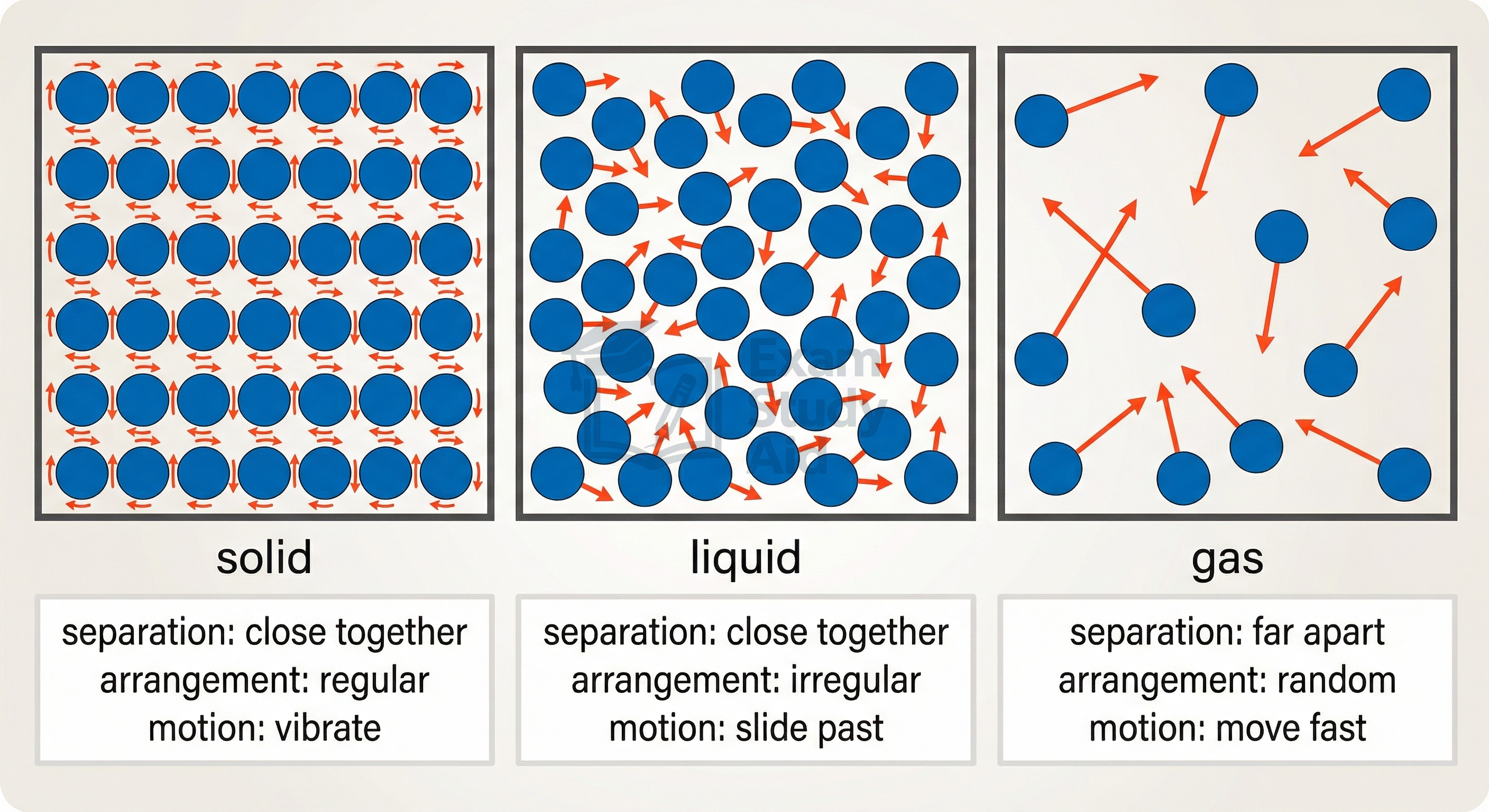
Exam TipEnsure the gas particles are drawn much further apart than the liquid particles — a common error is drawing them too close together.
Changes of State
A change of state is a physical change that occurs when a substance gains or loses energy, without forming a new substance.
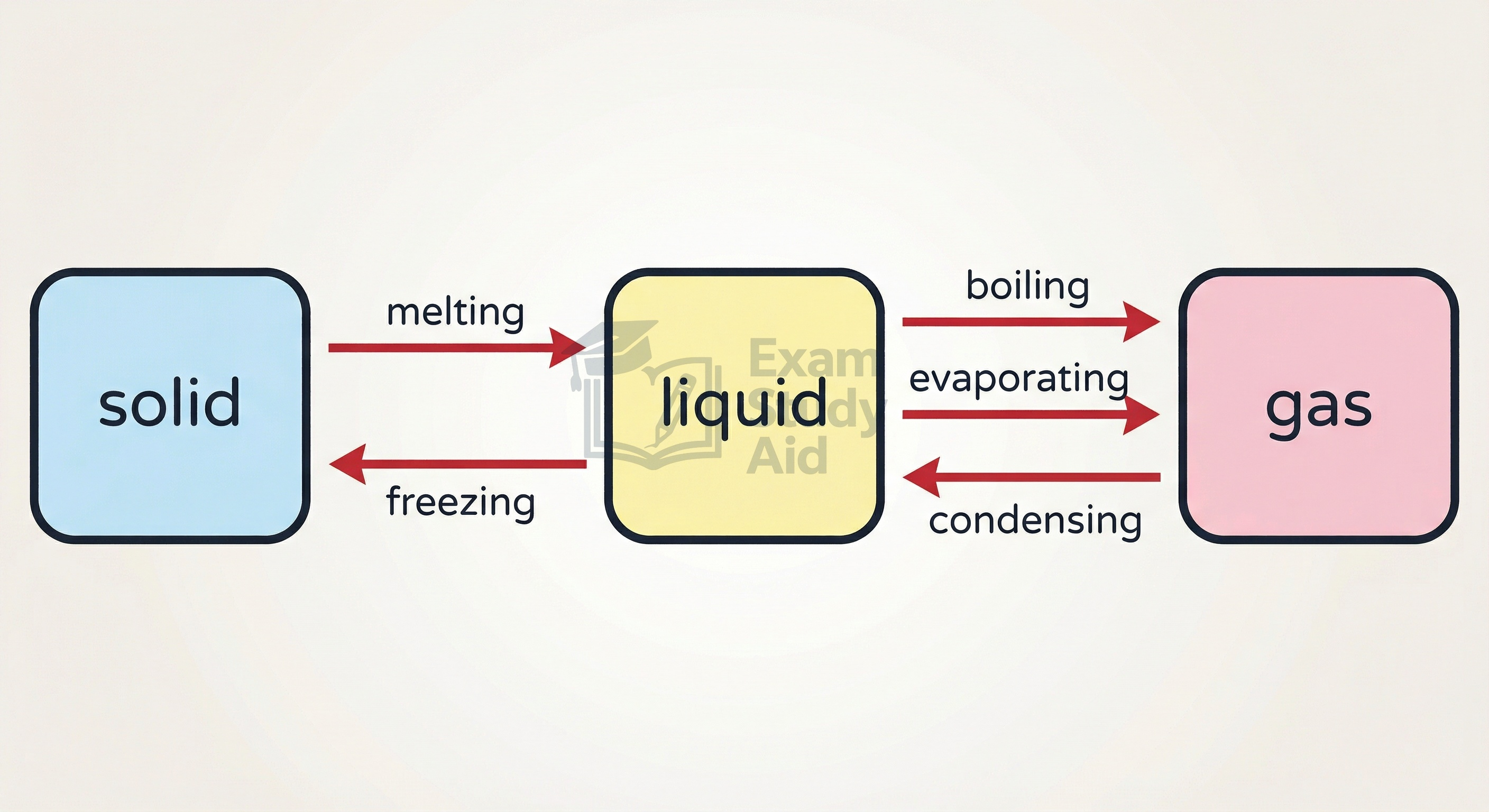
The five key changes of state are:
| Change of state | Direction | Energy change |
|---|---|---|
| Melting | Solid → Liquid | Energy absorbed |
| Boiling | Liquid → Gas | Energy absorbed |
| Evaporation | Liquid → Gas (from the surface, below boiling point) | Energy absorbed |
| Freezing | Liquid → Solid | Energy released |
| Condensing | Gas → Liquid | Energy released |
- Melting occurs when a solid gains enough energy for its particles to overcome some of the forces holding them in fixed positions, so they begin to move around each other.
- Boiling occurs at a fixed temperature throughout the liquid when particles gain enough energy to overcome all remaining attractions and escape as a gas.
- Evaporation differs from boiling because it occurs only at the surface of the liquid and happens at any temperature below the boiling point — the fastest-moving surface particles escape into the gas phase.
- Freezing is the reverse of melting: particles lose energy and lock into a regular arrangement.
- Condensing is the reverse of boiling: gas particles lose energy, slow down, and form a liquid.
During any change of state the substance itself does not change — no new chemical is formed. The process is reversible.
MisconceptionStudents often state that boiling and evaporation are the same process. Boiling occurs at a fixed temperature throughout the bulk liquid, while evaporation occurs only at the surface and at any temperature. Exam cue: if asked to distinguish the two, always state both the temperature condition and the location (surface vs throughout).
Effects of Temperature and Pressure on Gas Volume
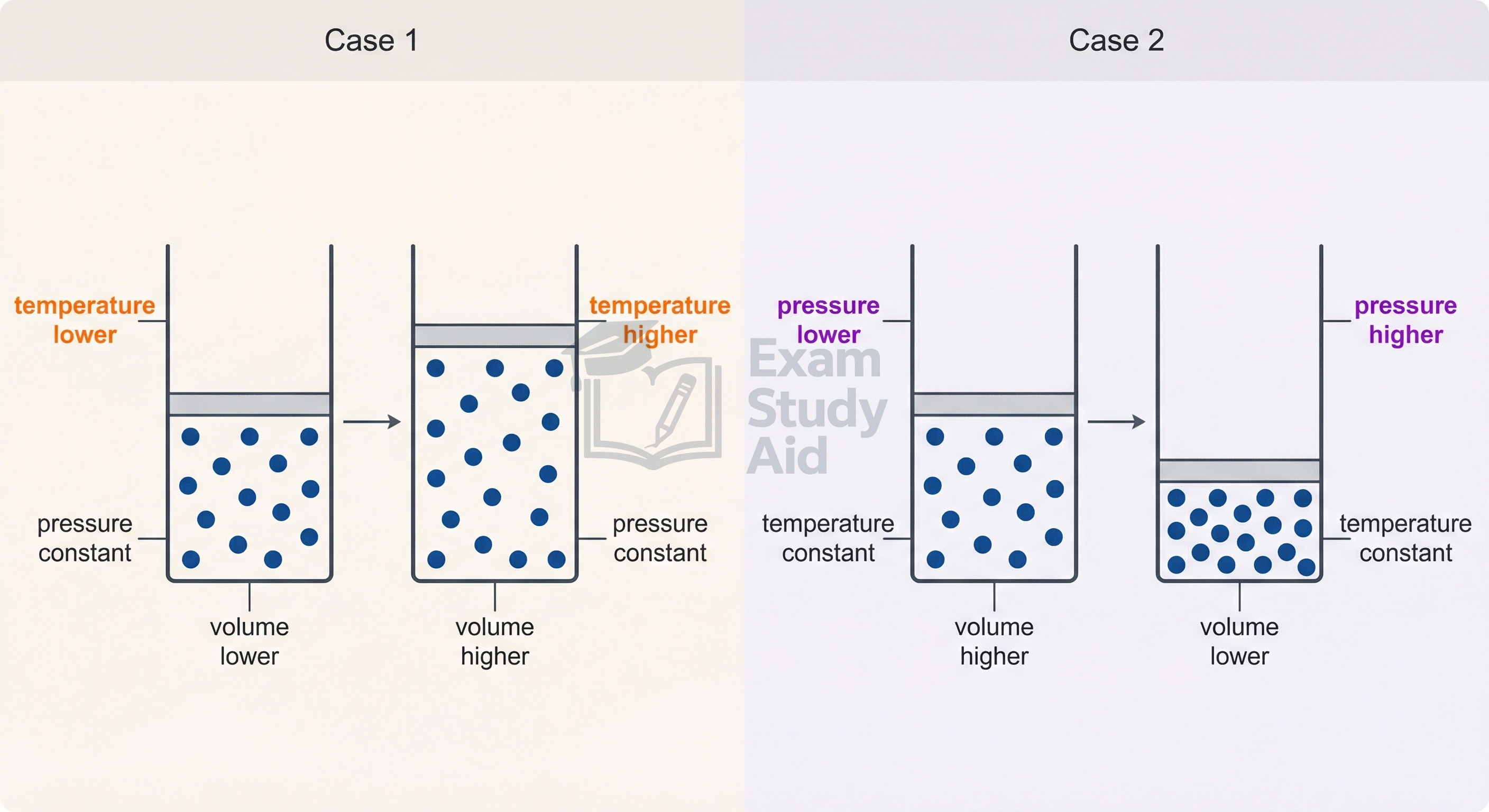
The volume of a gas changes when temperature or pressure changes, because gas particles are far apart and easily compressed.
Effect of temperature (at constant pressure): When the temperature of a gas increases, its volume increases. When the temperature decreases, the volume decreases. This happens because heating causes gas particles to move faster and push outward more forcefully, so the gas expands.
Effect of pressure (at constant temperature): When the pressure on a gas increases, its volume decreases. When the pressure decreases, the volume increases. Increasing pressure forces the widely spaced gas particles closer together, so the gas occupies a smaller volume.
Examiner InsightQuestions often present a sealed syringe scenario. If the plunger is pushed in (pressure increases), the gas volume decreases. If the syringe is heated, the gas expands and pushes the plunger out. Exam cue: always state the condition held constant (temperature or pressure) when describing the other variable's effect.
Extended Kinetic Particle Theory and Changes of State
Kinetic particle theory states that all particles are in constant motion and that the energy of this motion increases with temperature.
During melting, particles absorb energy and vibrate more vigorously until they overcome sufficient forces of attraction to leave their fixed positions and move around each other. During boiling, particles absorb enough energy to completely overcome all intermolecular forces and escape into the gas phase.
Extended During a change of state, the temperature remains constant even though energy is being supplied. This is because the energy absorbed is used to overcome forces of attraction between particles rather than to increase their kinetic energy. On a heating curve [a graph of temperature against time as a substance is heated steadily], the flat (horizontal) sections represent changes of state — melting and boiling — where temperature stays constant. The sloped sections represent temperature increases within a single state. A cooling curve is the reverse: flat sections show freezing and condensing, where energy is released as particles form stronger attractions.
How to read a heating or cooling curve: the x-axis shows time, the y-axis shows temperature. A flat horizontal region means a change of state is occurring. A rising or falling slope means the substance is heating or cooling within one state.
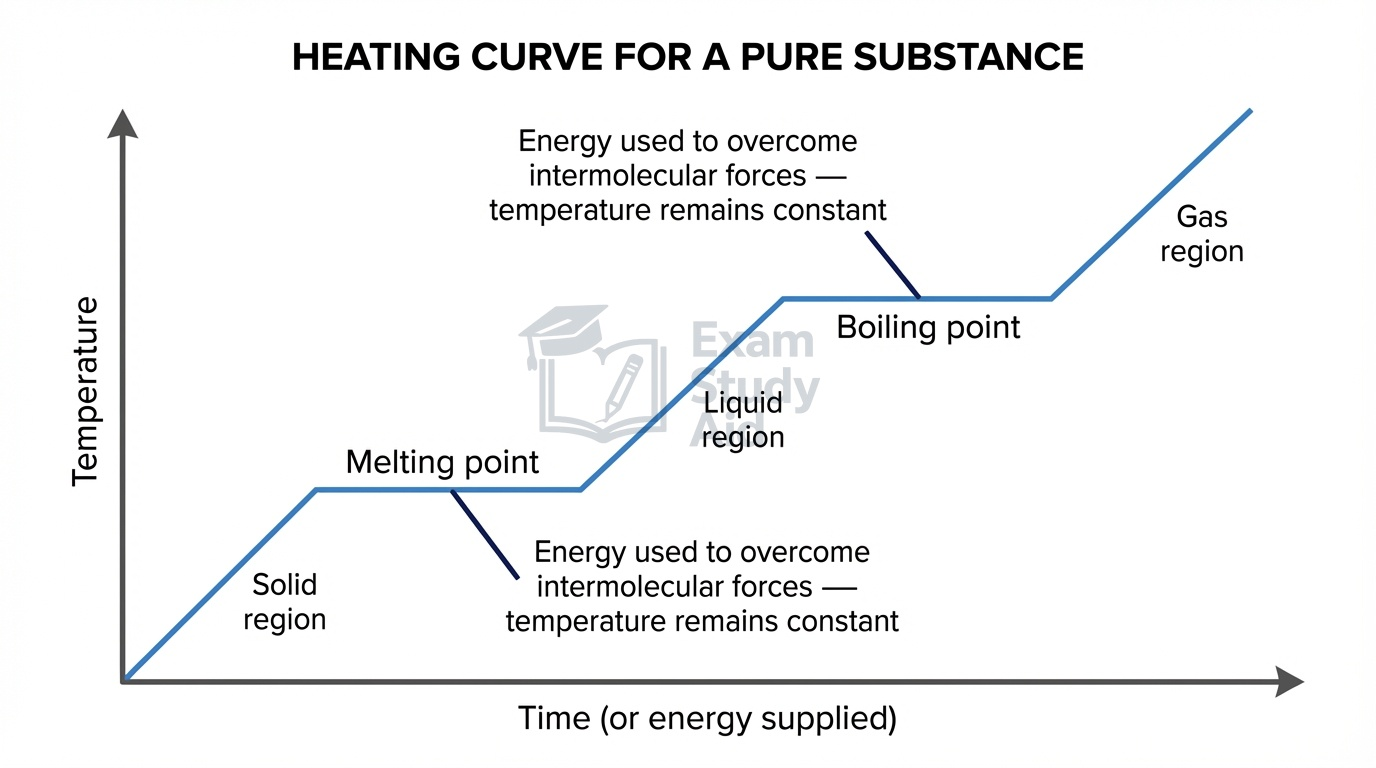
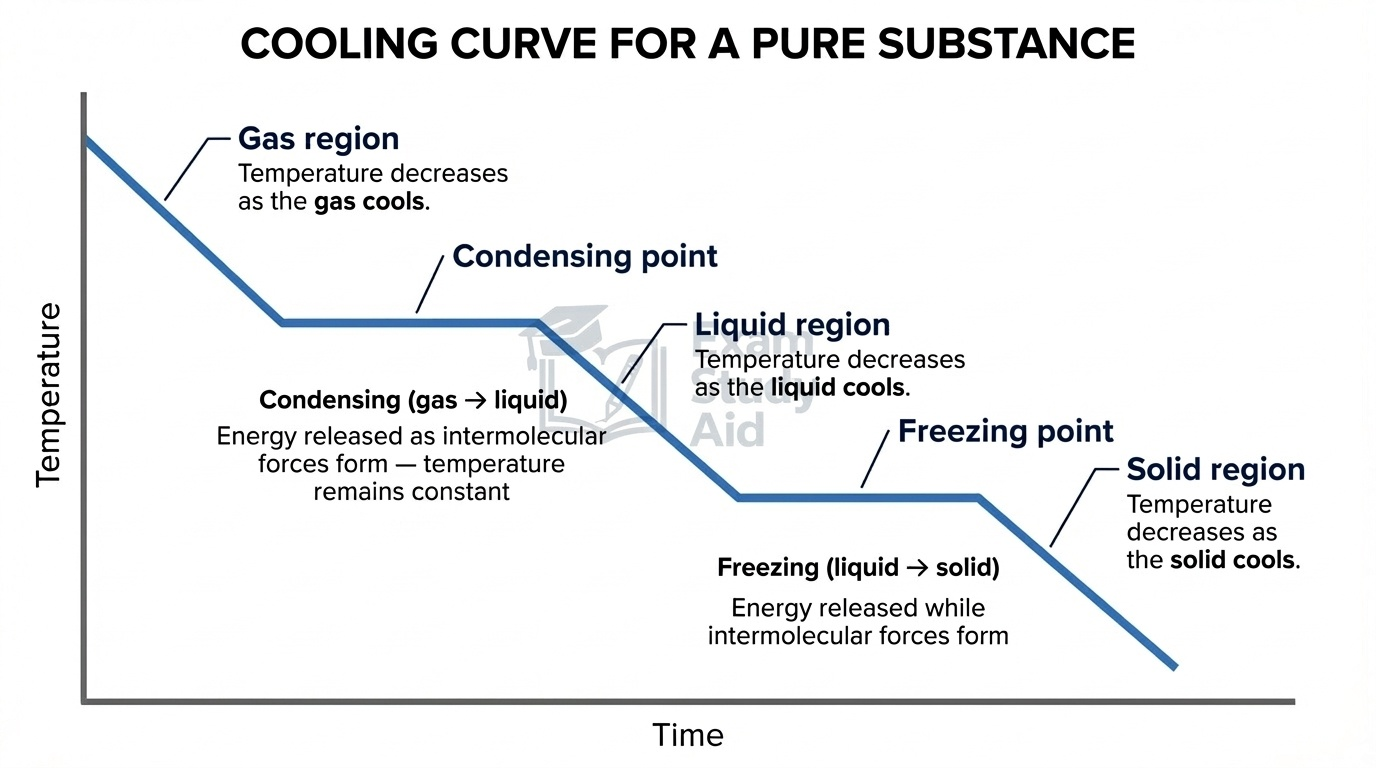
MisconceptionStudents sometimes believe that temperature rises during a change of state. Temperature remains constant during melting and boiling because all the energy supplied overcomes intermolecular forces (to switch to a different state of matter) rather than increasing kinetic energy.
Extended Kinetic Theory Explanation of Gas Behaviour
The kinetic particle theory explains how temperature and pressure affect the volume of a gas by considering particle motion and collisions.
Extended Effect of temperature on volume (constant pressure): When a gas is heated, its particles gain kinetic energy and move faster. The particles collide with the walls of the container more frequently and with greater force. If the container can expand (e.g. a balloon or a piston), the gas pushes outward and the volume increases until the pressure is balanced again. If the gas is cooled, particles lose kinetic energy, move more slowly, exert less force on the walls, and the volume decreases.
Extended Effect of pressure on volume (constant temperature): When external pressure on a gas increases, the gas particles are forced into a smaller space. The particles themselves do not change speed because the temperature is constant, but they are closer together. The volume decreases because the same number of particles now occupies less space. If the external pressure decreases, the particles spread out and the volume increases.
Examiner InsightA common 3-mark question asks you to explain, using kinetic theory, why increasing temperature at constant pressure increases volume. The expected chain is: particles gain kinetic energy → move faster → collide with container walls more forcefully and more frequently → walls are pushed outward → volume increases. Exam cue: always link kinetic energy to collision force explicitly — do not jump from "move faster" to "volume increases" without the collision step.
QUICK RECAP
Key Points
- Solids have a fixed shape and volume; particles vibrate in a regular arrangement.
- Liquids have a fixed volume but no fixed shape; particles slide past each other.
- Gas particles are far apart, move fast and randomly, and fill any container.
- Gases are easily compressed; solids and liquids are not.
- Melting, boiling and evaporation absorb energy; freezing and condensing release energy.
- Evaporation occurs at the surface at any temperature; boiling occurs throughout at a fixed temperature.
- Increasing temperature at constant pressure increases gas volume.
- Increasing pressure at constant temperature decreases gas volume.
- Extended During a change of state, temperature stays constant on a heating or cooling curve.
- Extended Energy during a change of state overcomes forces of attraction, not kinetic energy.
- Extended Faster-moving gas particles collide with walls more forcefully, increasing volume at constant pressure.
- Extended At constant temperature, higher pressure forces gas particles closer together, reducing volume.
CAN I…? PROGRESS CHECK
Self-Assessment
- State the distinguishing properties of solids, liquids and gases?
- Describe particle arrangement, separation and motion in each state?
- Name and describe the five changes of state?
- Distinguish between boiling and evaporation?
- Describe how temperature and pressure affect gas volume?
- Extended Explain why temperature stays constant during a change of state?
- Extended Interpret flat and sloped sections on heating and cooling curves?
- Extended Explain gas behaviour under changing temperature and pressure using kinetic particle theory?