
1.6: MOMENTUM
Learning Objectives
4 objectivesMaster the key concepts you need to know.
Define momentum and use the equation p = mv
Define impulse and use the equation impulse = FΔt = Δ(mv)
Apply the conservation of momentum in one dimension
Define resultant force as change in momentum per unit time and use F = Δp / Δt
CORE VS EXTENDED GUIDE
-
📌 Core students study only the unlabelled sections.
-
📌 Extended students must study everything, including 🚀 Extended points.
-
📌 Extended = Core + Supplement.
🚀 Momentum
Key Equations
Momentum:
$$ p = mv $$
Variables:
-
$p$ = momentum, in kg m s⁻¹ (or N s)
-
$m$ = mass, in kg
-
$v$ = velocity, in m s⁻¹
SI unit of momentum: kg m s⁻¹
Rearrangements:
$$ m = \frac{p}{v} \qquad v = \frac{p}{m} $$
Proportionality: Momentum is directly proportional to mass when velocity is constant. Momentum is directly proportional to velocity when mass is constant. Therefore, doubling either mass or velocity doubles the momentum.
📌 Momentum is the product of mass and velocity.
Momentum describes how much "motion content" an object carries — a heavy lorry at low speed can have the same momentum as a light car at high speed. Because velocity is a vector quantity, momentum is also a vector: its direction is the same as the direction of the object's velocity. This means two objects moving in opposite directions have momenta [plural of momentum] with opposite signs.
Sign convention for one-dimensional problems: choose one direction as positive (e.g. rightward = positive). Any object moving in the opposite direction has a negative velocity, and therefore a negative momentum.
MisconceptionStudents sometimes treat momentum as a scalar and ignore direction. Momentum is a vector. In every calculation, assign a positive direction first and use negative signs for the opposite direction. Exam cue: always state "Taking [direction] as positive" before substituting values.
Worked Example
A car of mass 1200 kg travels eastward at 25 m s⁻¹. Calculate its momentum.
Finding the momentum
Equation used:
$$ p = mv $$
Given:
$$ m = 1200 \text{ kg} $$
$$ v = 25 \text{ m s}^{-1} $$
Substitution:
$$ p = 1200 \times 25 $$
$$ p = 30\,000 \text{ kg m s}^{-1} \text{ eastward} $$
🚀 Impulse
Key Equations
Impulse:
$$ \text{impulse} = F \Delta t = \Delta(mv) $$
Variables:
-
$F$ = force, in N
-
$\Delta t$ = time for which the force acts, in s
-
$\Delta(mv)$ = change in momentum, in kg m s⁻¹
SI unit of impulse: N s (equivalent to kg m s⁻¹)
Rearrangements:
$$ F = \frac{\Delta(mv)}{\Delta t} \qquad \Delta t = \frac{\Delta(mv)}{F} $$
Proportionality: Impulse is directly proportional to the force when time is constant. Impulse is directly proportional to the time when force is constant. Doubling the force doubles the impulse (for the same time interval).
📌 Impulse is the product of force and the time for which the force acts.
Impulse equals the change in momentum of the object. A large force acting for a short time can produce the same change in momentum as a small force acting for a longer time — this is why car crumple zones work. The crumple zone increases the collision time $\Delta t$, so for the same change in momentum, the force $F$ on the passengers decreases.
Examiner InsightCIE commonly asks "explain how a safety feature reduces injury." The required chain is: the feature increases the time of impact → for the same change in momentum, impulse = FΔt → the force is reduced → less injury. Exam cue: always link the longer time to a smaller force via the impulse equation.
Worked Example
A 0.40 kg ball hits a wall at 12 m s⁻¹ and bounces back at 8.0 m s⁻¹. The contact time with the wall is 0.050 s. Calculate the force exerted by the wall on the ball.
Taking the initial direction of travel (towards the wall) as positive.
Step 1: Finding the change in momentum
$$ \Delta(mv) = mv_{\text{final}} - mv_{\text{initial}} $$
Given:
$$ m = 0.40 \text{ kg} $$
$$ v_{\text{initial}} = +12 \text{ m s}^{-1} $$
$$ v_{\text{final}} = -8.0 \text{ m s}^{-1} $$
The ball reverses direction, so $v_{\text{final}}$ is negative.
$$ \Delta(mv) = 0.40 \times (-8.0) - 0.40 \times (+12) $$
$$ \Delta(mv) = -3.2 - 4.8 $$
$$ \Delta(mv) = -8.0 \text{ kg m s}^{-1} $$
Step 2: Finding the force
Equation used:
$$ F = \frac{\Delta(mv)}{\Delta t} $$
Given:
$$ \Delta t = 0.050 \text{ s} $$
Substitution:
$$ F = \frac{-8.0}{0.050} $$
$$ F = -160 \text{ N} $$
The magnitude of the force is 160 N. The negative sign indicates the force acts in the direction away from the wall (opposing the ball's initial motion), as expected.
🚀 Conservation of Momentum
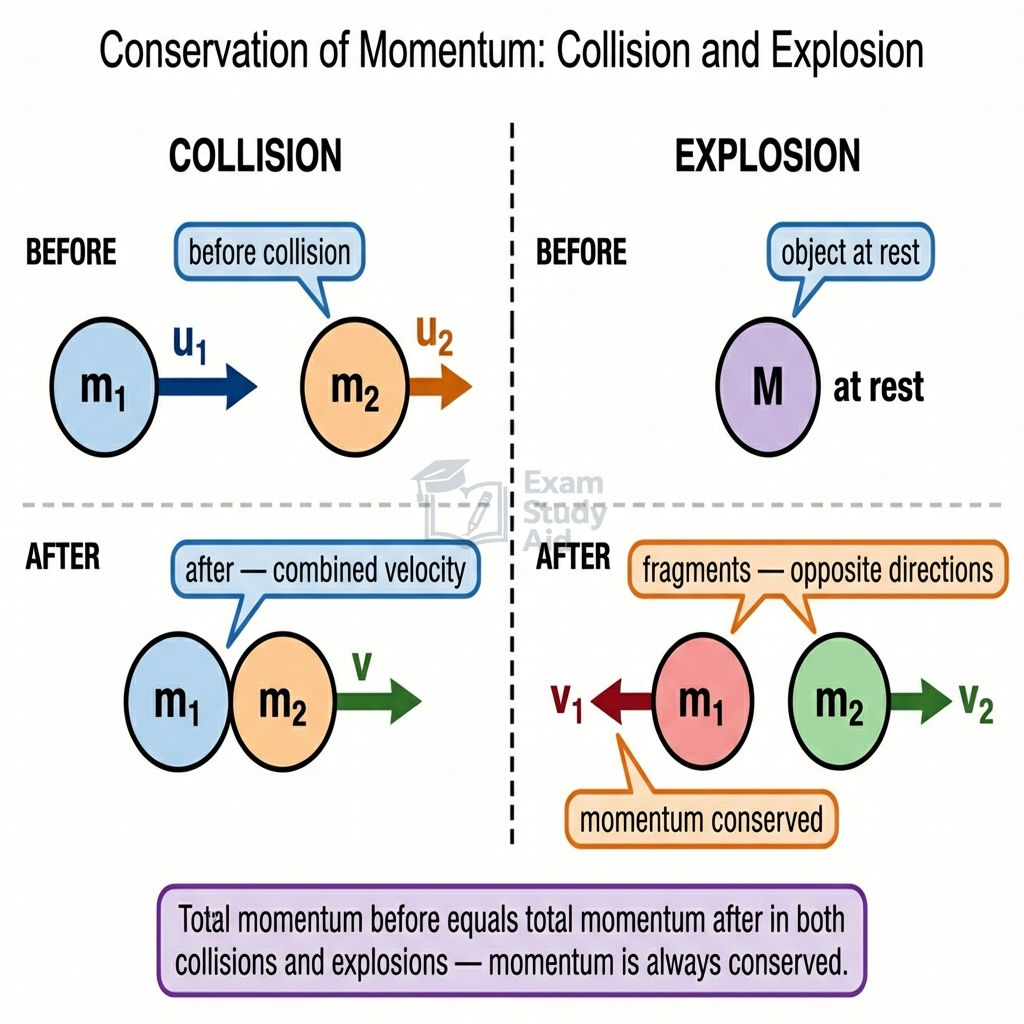
📌 The principle of the conservation of momentum states that the total momentum of a system of objects remains constant, provided no resultant external force acts on the system.
This means that in any collision or explosion, the total momentum before the event equals the total momentum after the event:
$$ \text{total momentum before} = \text{total momentum after} $$
$$ m_1 u_1 + m_2 u_2 = m_1 v_1 + m_2 v_2 $$
where $u$ represents velocity before and $v$ represents velocity after.
This principle applies to all types of interaction in one dimension:
| Type | Description | Momentum conserved? | Kinetic energy conserved? |
|---|---|---|---|
| Elastic collision | Objects bounce apart | Yes | Yes |
| Inelastic collision | Objects may deform; some KE transferred to thermal store | Yes | No |
| Perfectly inelastic collision | Objects stick together and move as one | Yes | No |
| Explosion | Objects initially at rest fly apart | Yes (total = 0 before and after) | No (KE increases from chemical store) |
For an explosion from rest, the total initial momentum is zero. Therefore the total final momentum must also be zero, meaning the momenta of the fragments are equal in magnitude but opposite in direction.
MisconceptionStudents often think momentum is not conserved when objects stop after a collision. If both objects stop, the total momentum after is zero — which means the total momentum before was also zero (they were moving in opposite directions with equal-magnitude momenta). Exam cue: momentum is always conserved in the absence of external forces, regardless of what happens to kinetic energy.
Worked Example — Collision
A 2.0 kg trolley moving at 3.0 m s⁻¹ to the right collides with a stationary 1.0 kg trolley. After the collision, they stick together. Calculate the velocity of the combined trolleys after the collision.
Taking rightward as positive.
Finding the velocity after collision
Equation used:
$$ m_1 u_1 + m_2 u_2 = (m_1 + m_2) v $$
Given:
$$ m_1 = 2.0 \text{ kg}, \quad u_1 = +3.0 \text{ m s}^{-1} $$
$$ m_2 = 1.0 \text{ kg}, \quad u_2 = 0 \text{ m s}^{-1} $$
Substitution:
$$ (2.0 \times 3.0) + (1.0 \times 0) = (2.0 + 1.0) \times v $$
$$ 6.0 = 3.0 \times v $$
Rearranging for $v$:
$$ v = \frac{6.0}{3.0} $$
$$ v = 2.0 \text{ m s}^{-1} \text{ to the right} $$
Worked Example — Explosion
A 3.0 kg cannon fires a 0.020 kg ball at 150 m s⁻¹. Calculate the recoil velocity of the cannon.
Taking the direction of the ball as positive. Total momentum before firing = 0 (both at rest).
Finding the recoil velocity
$$ \text{total momentum before} = \text{total momentum after} $$
$$ 0 = m_{\text{ball}} v_{\text{ball}} + m_{\text{cannon}} v_{\text{cannon}} $$
Substitution:
$$ 0 = (0.020 \times 150) + (3.0 \times v_{\text{cannon}}) $$
$$ 0 = 3.0 + 3.0 \times v_{\text{cannon}} $$
Rearranging for $v_{\text{cannon}}$:
$$ v_{\text{cannon}} = \frac{-3.0}{3.0} $$
$$ v_{\text{cannon}} = -1.0 \text{ m s}^{-1} $$
The negative sign indicates the cannon recoils in the opposite direction to the ball, as expected.
Exam Tipensure arrow directions match the sign convention chosen, and label all masses and velocities with values.
🚀 Resultant Force and Rate of Change of Momentum
Key Equations
Resultant force (Newton's second law in momentum form):
$$ F = \frac{\Delta p}{\Delta t} $$
Variables:
-
$F$ = resultant force, in N
-
$\Delta p$ = change in momentum, in kg m s⁻¹
-
$\Delta t$ = time interval, in s
SI unit: N (where 1 N = 1 kg m s⁻² = 1 kg m s⁻¹ per s)
Rearrangements:
$$ \Delta p = F \Delta t \qquad \Delta t = \frac{\Delta p}{F} $$
Proportionality: Resultant force is directly proportional to the change in momentum when time is constant. Resultant force is inversely proportional to the time interval when the change in momentum is constant. Doubling the time over which the same momentum change occurs halves the force.
📌 Resultant force is the change in momentum per unit time.
This equation is the most general form of Newton's second law. When mass is constant, $F = \frac{\Delta(mv)}{\Delta t}$ simplifies to $F = m \times \frac{\Delta v}{\Delta t} = ma$. However, the momentum form is more powerful because it also applies to situations where mass changes (such as a rocket burning fuel), and it directly links force to impulse.
The direction of the resultant force is the same as the direction of the change in momentum. If no resultant force acts, $\Delta p = 0$, so momentum is conserved — this connects directly back to the conservation of momentum principle.
Examiner InsightCIE may give a momentum--time graph and ask for the resultant force. The gradient of a momentum--time graph equals the resultant force, because gradient = $\frac{\Delta p}{\Delta t} = F$. A steeper gradient means a larger force. Exam cue: if given a p--t graph, calculate the gradient to find the force.
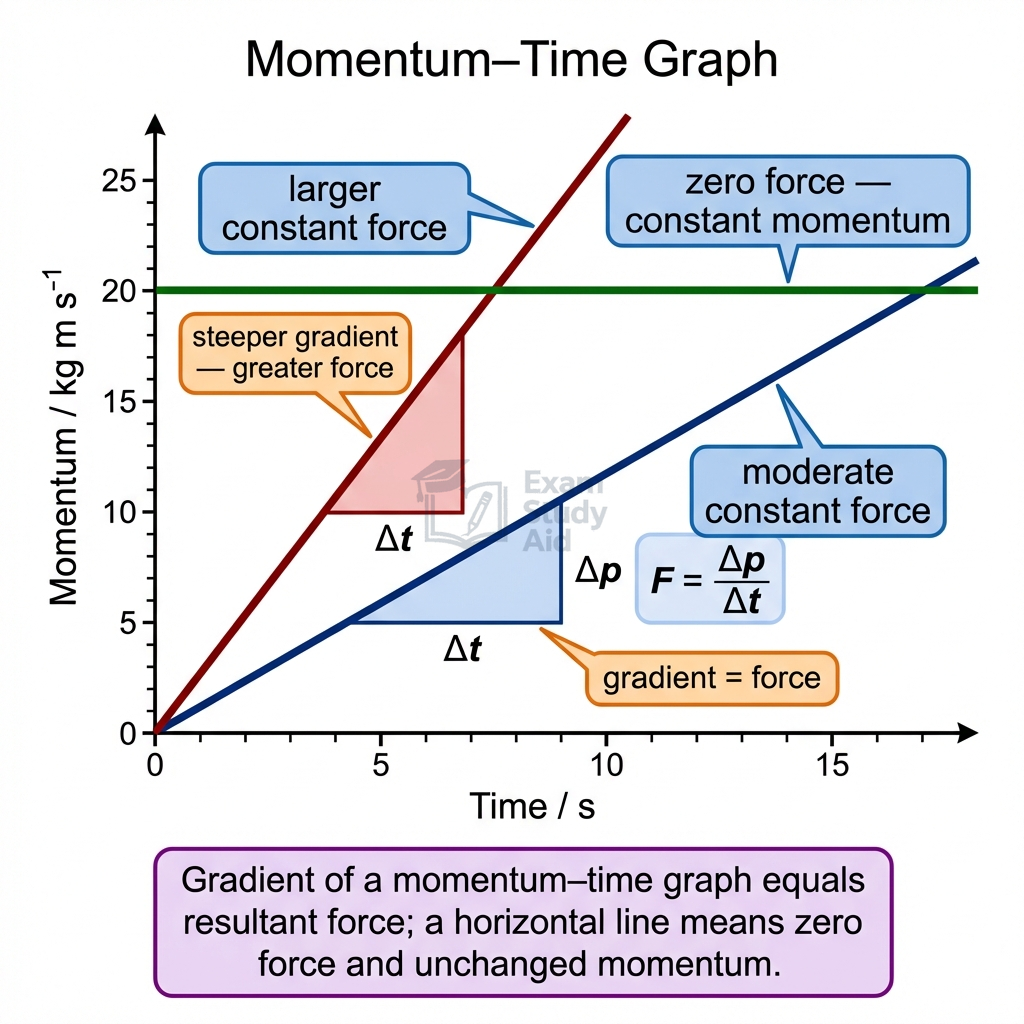
Exam Tipread the gradient carefully — use Δp ÷ Δt from two widely separated points on the line for accuracy.
Worked Example
A 1500 kg car accelerates from 10 m s⁻¹ to 22 m s⁻¹ in 8.0 s. Calculate the resultant force acting on the car.
Step 1: Finding the change in momentum
$$ \Delta p = mv_{\text{final}} - mv_{\text{initial}} $$
Given:
$$ m = 1500 \text{ kg} $$
$$ v_{\text{initial}} = 10 \text{ m s}^{-1} $$
$$ v_{\text{final}} = 22 \text{ m s}^{-1} $$
$$ \Delta p = (1500 \times 22) - (1500 \times 10) $$
$$ \Delta p = 33\,000 - 15\,000 $$
$$ \Delta p = 18\,000 \text{ kg m s}^{-1} $$
Step 2: Finding the resultant force
$$ F = \frac{\Delta p}{\Delta t} $$
Given:
$$ \Delta t = 8.0 \text{ s} $$
$$ F = \frac{18\,000}{8.0} $$
$$ F = 2250 \text{ N} $$
$$ F \approx 2300 \text{ N (2 s.f.)} $$
QUICK RECAP
Key Points
-
🚀 Momentum = mass × velocity; unit: kg m s⁻¹
-
🚀 Momentum is a vector in the direction of velocity
-
🚀 Assign a positive direction before solving momentum problems
-
🚀 Impulse = force × time = change in momentum
-
🚀 Unit of impulse: N s, equivalent to kg m s⁻¹
-
🚀 Longer collision time → smaller force for same momentum change
-
🚀 Total momentum before = total momentum after (no external force)
-
🚀 Conservation applies to collisions and explosions
-
🚀 In an explosion from rest, total final momentum = 0
-
🚀 Resultant force = change in momentum per unit time
-
🚀 F = Δp / Δt is the general form of Newton's second law
-
🚀 Gradient of a momentum--time graph = resultant force
CAN I...? PROGRESS CHECK
Self-Assessment
-
🚀 Define momentum and calculate it using p = mv?
-
🚀 Define impulse and use impulse = FΔt = Δ(mv)?
-
🚀 Assign a sign convention and apply it consistently to vector quantities?
-
🚀 Apply conservation of momentum to collisions and explosions in one dimension?
-
🚀 Explain why a longer collision time reduces the force?
-
🚀 Define resultant force as Δp / Δt and use this equation?
-
🚀 Interpret the gradient of a momentum--time graph as resultant force?